
“Let’s go to our castle, Ella. I saw two monkeys coming so I left the catapult ready!” Marcus and his friend Ella joining forces to tackle life in the jungle. By Marta Kaltreider.
After a beautiful and intense first term of school, off we go on a long week break to the Island of Sumatra with our dear friends, the Nolan Family.
Located in Western Indonesia, Sumatra is the largest of the islands of the archipelago – Borneo and Papua, although greater in size, share their island mass between Indonesia and other countries. Sumatra sits on the Pacific Ring of Fire and the Equator crosses the island near the center. This beautiful island is a gift of magnificent volcanos, swampy plains, fertile land and breathtaking scenery.
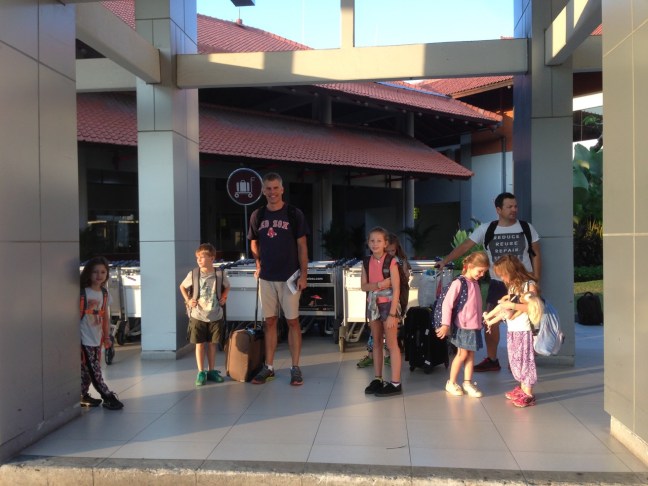
We will be exploring the Northern tip, deep into the jungle; no internet, no cell coverage, limited electricity, and a long journey from Bali. After a 4:45 am start in Ubud, two flights, 7 hours of rickety drive and a 40 minute dark, adventurous and very wet jungle hike we arrive! Welcome to the middle of nowhere… Ahhh… what a gift to be able to ease off into a deep sleep to the deafening sounds of the wilderness…
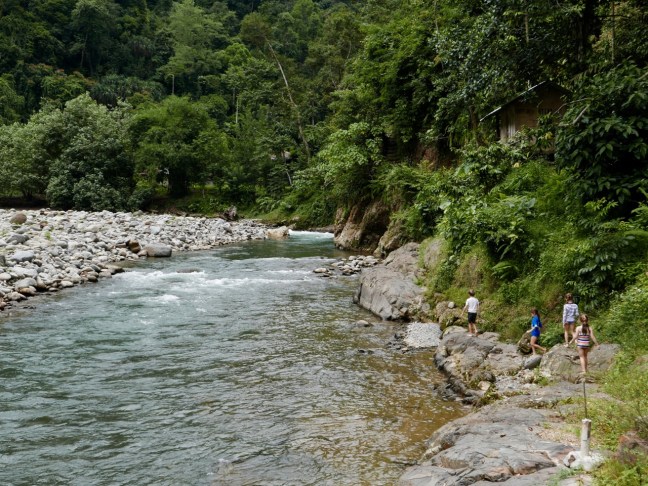
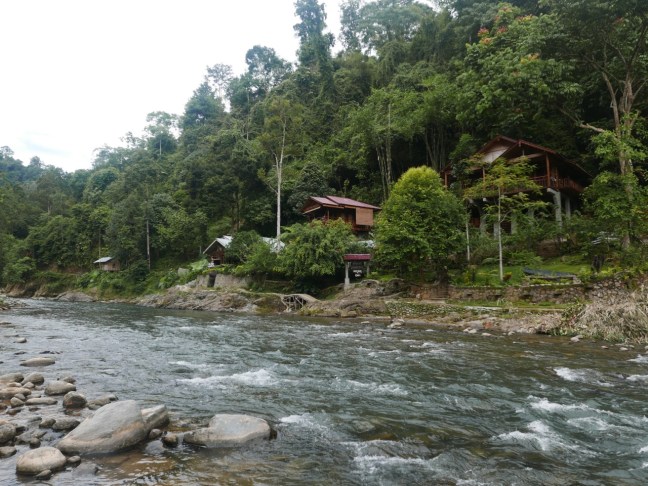
Excitedly, and after a night of choppy sleep from listening to the powerful voice of the jungle, I wake up at the crack of dawn only to be hit by the indescribable peace and beauty that surrounds me. I write these words inspired by what lays in front of my senses and I am at a loss for words to do it justice. Here I am, greeted by an endless river gorge colored in an infinite rainbow of greens, bathed by crystal clear waters and decorated by sculptural, naturally-polished river rock formations.
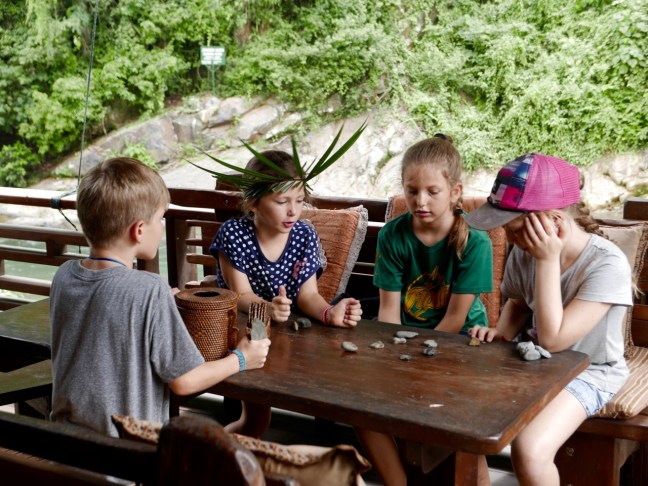
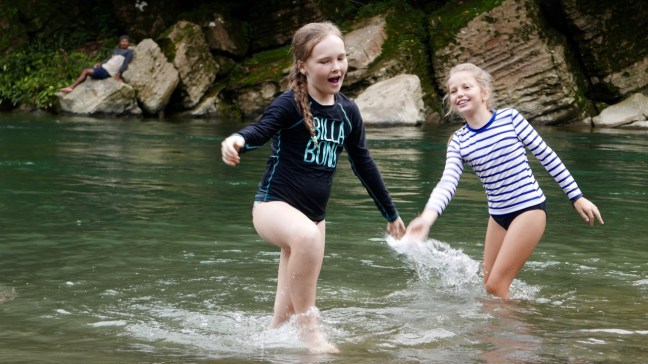
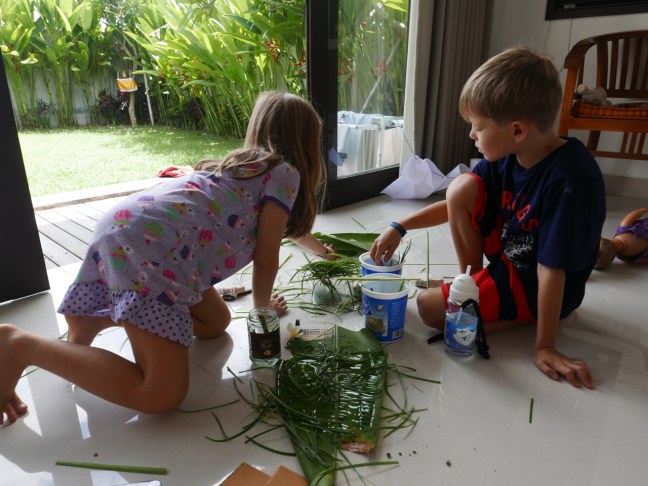
A sudden feeling of immense gratitude invades me and sinks in deeper and deeper as the next two days peacefully flow and slowly unfold moment by moment. We swim the impossibly crisp waters of the river, we play cards, we feast on fresh homemade local dishes, we admire the industriousness of our children building dams and castles, we write, we draw, we even take on the river rapids on inner tubes down to the small village of Bukit Lawang… and it all sort of happens… without rushing, without planning, without trying… beautifully, peacefully… Thank you mother nature. I feel like a child again. The jungle seems to free and simplify all of us, and after two months of intense personal pacing and deep introspection I can let go and enter a most liberating, enlightening and fulfilling state-of-mind.
Today we are ready for some serious excitement and we are off on a hike in search of wildlife at the Gunung Leuser National Park. The Eastern rim of the Gunung Leuser National Park sits right across from us at the opposite side of the river bank. This national park is home to a diverse array of wildlife species including primates, big cats, reptiles and birds. The Gunung Leuser National Park is one of only two places in the world where is still possible to admire orangutans in their natural habitat (the other place is the Indonesian island of Borneo).
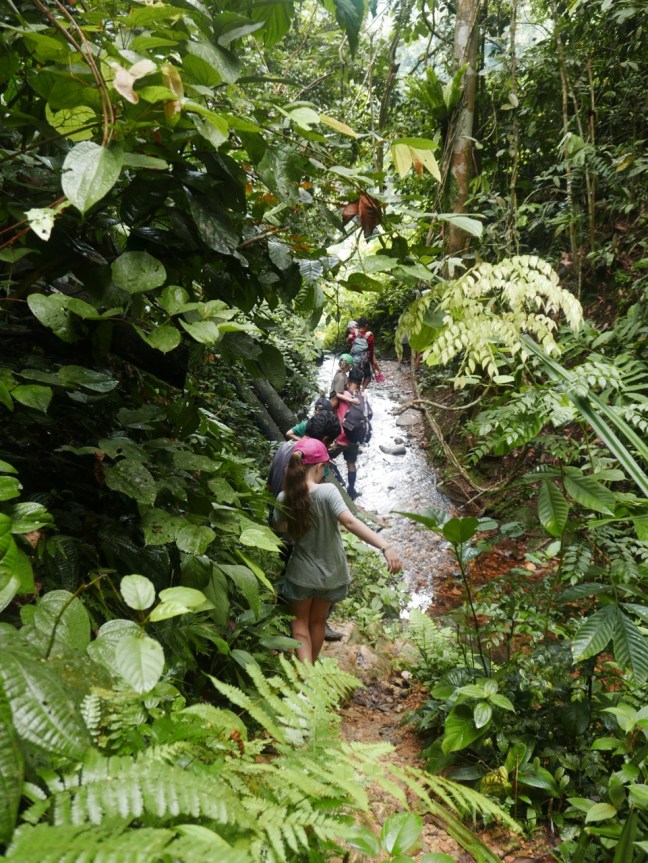
And so our hike begins as we cross the river just outside our jungle hut – literally! – accompanied by our trusting guides: Pak Rasta, Pak Arif, Pak Andi and Pak Ilham. The hike up the green wall we have been admiring from across the river for the last couple of days proves to be steep, dense, thick and muddy yet beautiful, fun and giving. Along the way we are greeted by a family of Thomas Leaf Monkeys (colloquially called Funky Monkeys), that are as intrigued and interested in us as we are of them. Thankfully, unlike the vicious monkeys in Ubud, these are gentle animals.
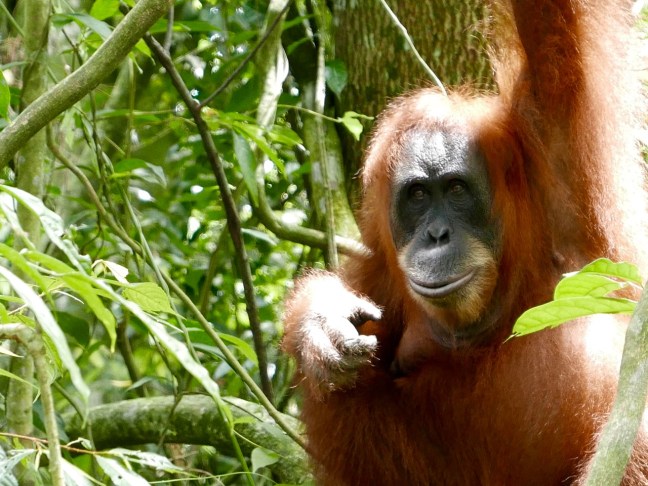
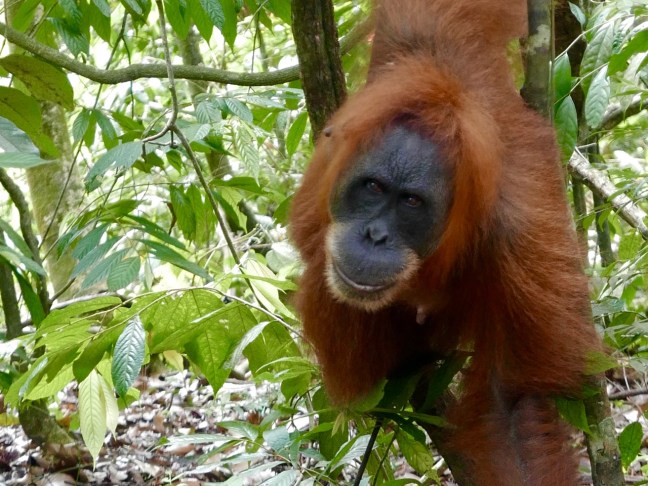
And if that wasn’t enough already, as we continue on with our hike, we come to find a whole group of female orangutans with their babies! Hanging playfully from the jungle’s canopy, they seem to defy the laws of gravity. Their beautiful copper coats weightlessly swing from branch to branch with sensational grace and agility. My heart is pounding as I admire these magnificent creatures complement the green palette of the jungle with bright, burnt-sienna splashes of color.
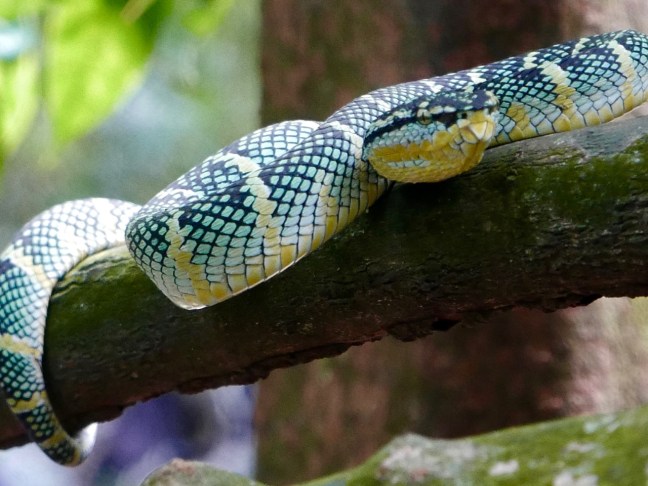
We get distracted by the sighting of a Pit Viper taking its month-long nap in front of us on a low tree branch. We wearily wonder at this beautiful and powerful creature; one bite and we are dead in less than one hour!
Just as we think it cannot not get any better, from the heights of the canopy, down come the orangutans, right by us, and my eyes fill up with tears of excitement and gratitude. The female orangutans are familiarly expressive. Their bodies are big… huge… and their presence: mighty.
Unfortunately, the population of orangutans (in Indonesian ‘orang’ means ‘people’ and ‘utan’ means ‘forest’ so orangutan literally means ‘people of the forest’), is rapidly declining and these beautiful “people of the forest” are doomed to vanish by 2050… or maybe even sooner! Our demand for palm oil is the main cause of jungle deforestation, driving orangutans and many other animals such as Sumatran rhinos, tigers and elephants to extinction.
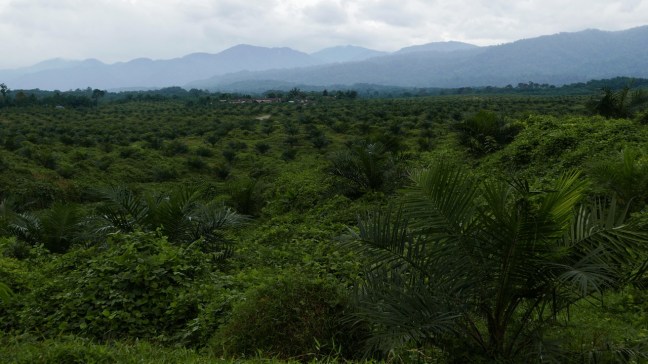
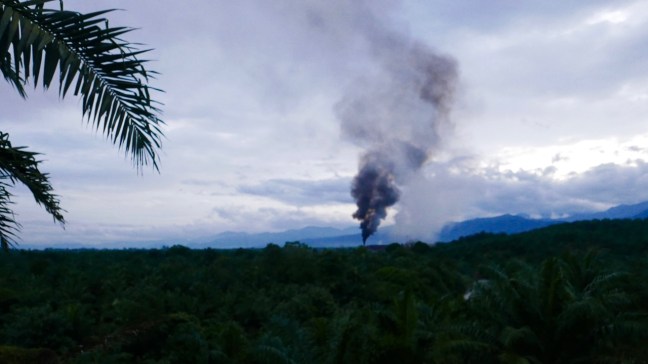
As we explore Northern Sumatra, mile after mile along the roads and acre after acre all the way to the horizon, the jungle has been replaced by palm oil plantations. It is heart breaking to see the effects and implications of deforestation. Along with the jungle, gone is the culture, the traditions, the integrity of the natives and the biodiversity that once ruled this land.
From the far distance, palm oil plantations paint the picture of lush green scenery but that view shifts very quickly as you get a close-up. On the spot, palm oil plantations look eerie, sinister, solitary and stale. Nothing can grown around them. They deteriorate the earth by exhausting the nutrients of the soil and by draining the water from the ground, leaving nothing for other plants to grow and for any animals to live. On average the commercial life span of a palm oil tree is approximately 25 years, so to put this into perspective, one 25 year old palm oil tree will absorb 25 liters of water per day.
Palm oil is the cheap alternative filler used in the manufacturing of cosmetics, sweets, snacks and soaps. At the cost of jungle deforestation, child labor, the integrity of indigenous people, animal extinction and the loss of local culture, just to name a few, we are catering to the excess that fill up our bathroom vanities with beauty products and our kitchen pantries with non-nutritious foods. Food for thought…












 theintrepid5: the Kaltreider adventure