
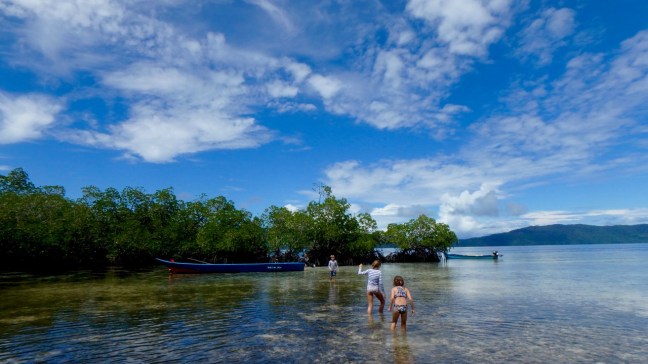
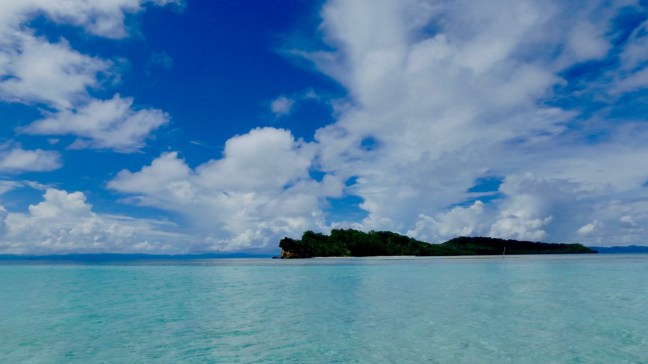
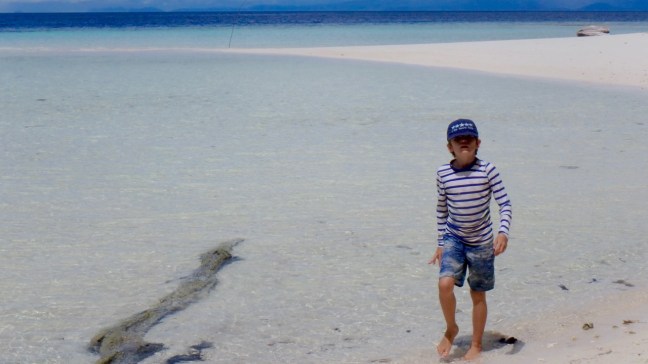
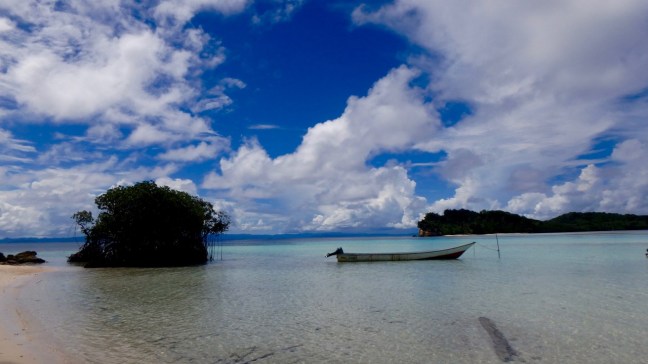
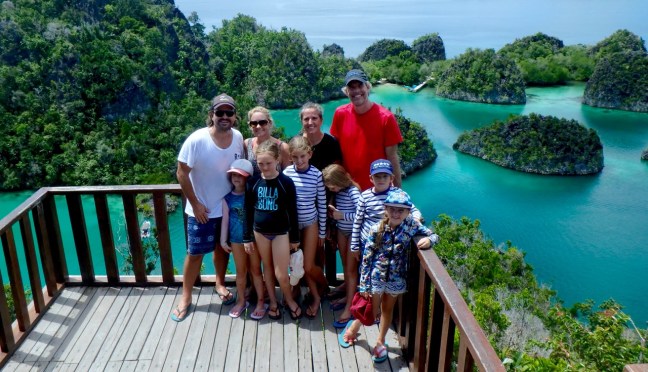
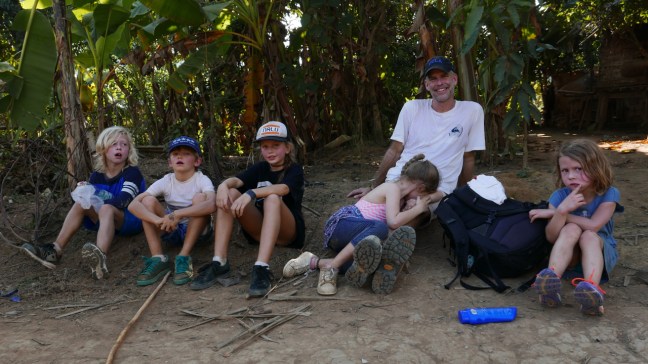
Ella: Where are we? Marta: What do you mean? Ella: I mean, where are we exactly in this moment? Marta: Oh! I see… We are in the tiny island of Gam, in the archipelago of Raja Ampat, Regency of West Papua, in Indonesia. Ella: Ah… Thank you. When Marcus and his friend Ella are trying to figure out where we are geographically. By Marta Kaltreider.
A one way ticket and no agenda takes us to the furthest Eastern corner of Indonesia: West Papua. We leave behind a fulfilling year packed with unforgettable memories that warm our hearts, life-changing experiences that have nourished our souls, enormous challenges that have made us grow and heartfelt goodbyes to many generous, kind and inspiring friends that we miss already. Ahead of us, a 5 week journey awaits. An unrehearsed, unplanned and unknown voyage meandering through the wonders of Indonesia. And so our adventure begins…
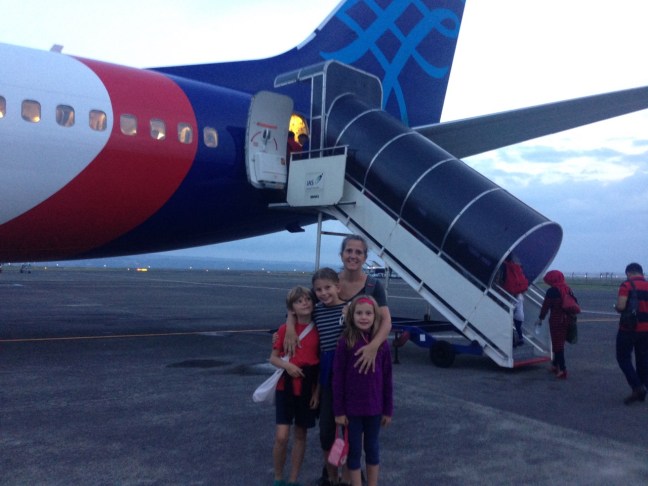
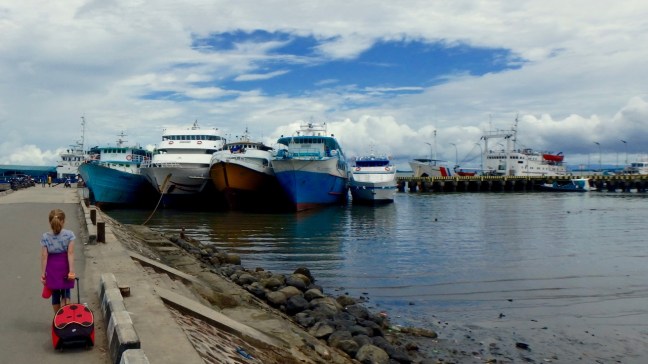
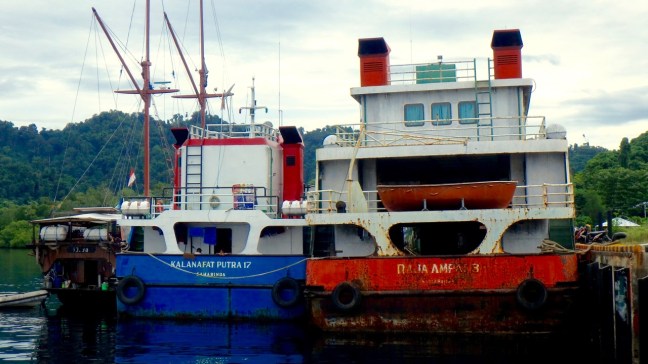
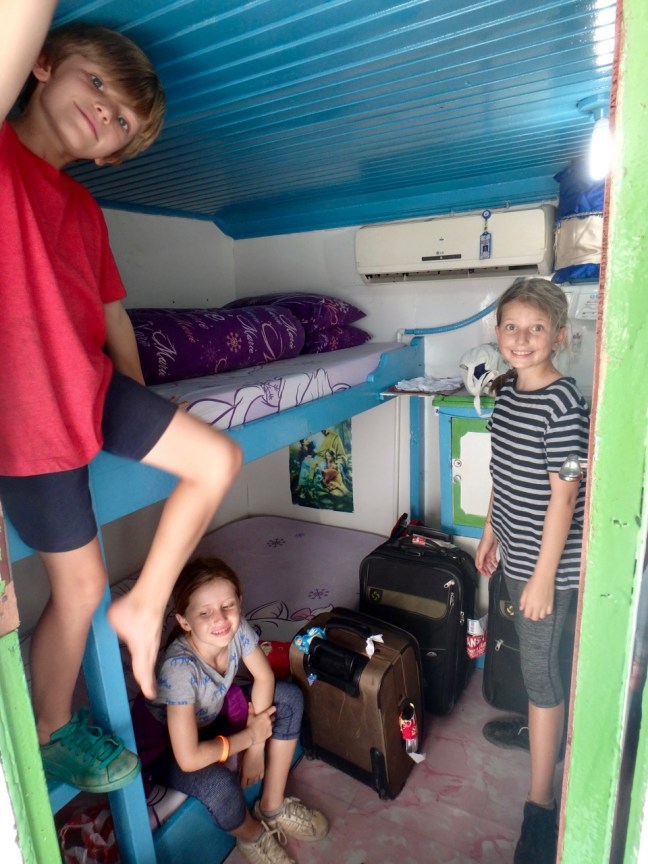
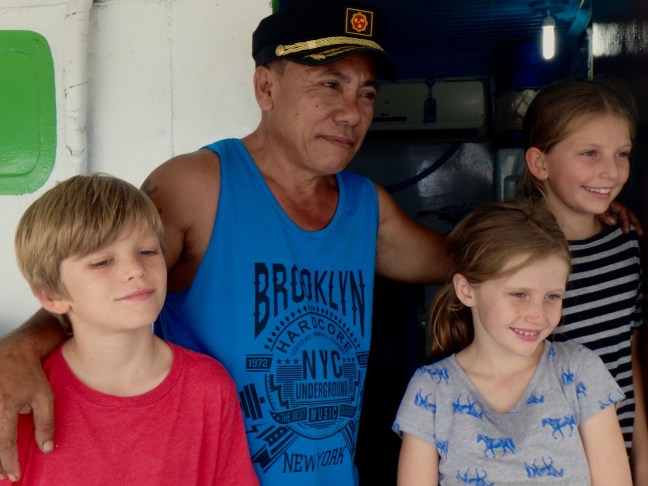
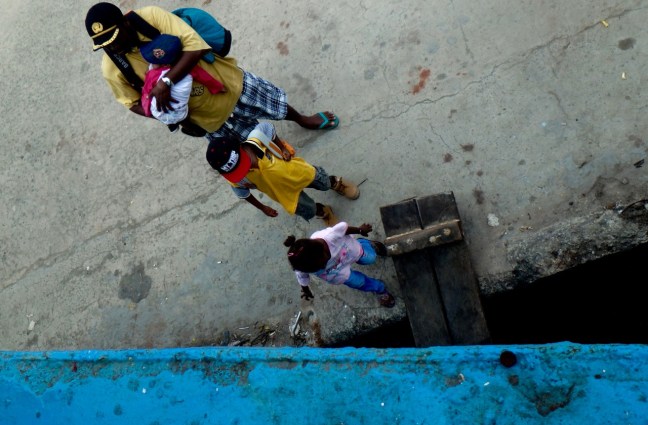
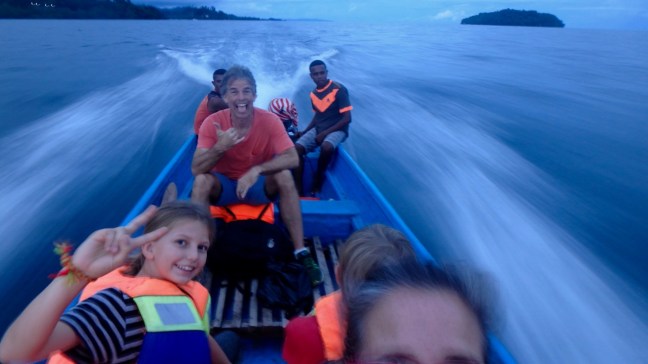
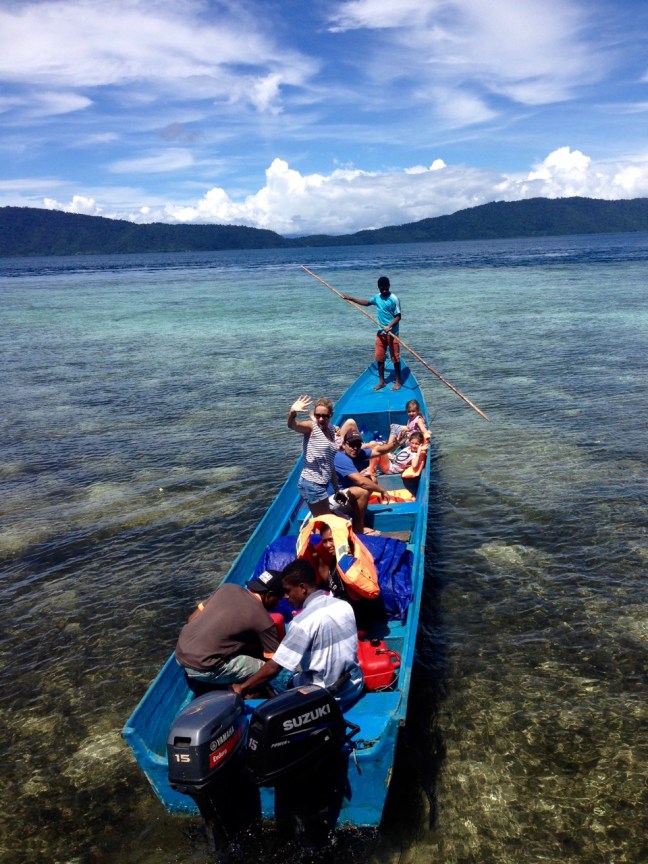
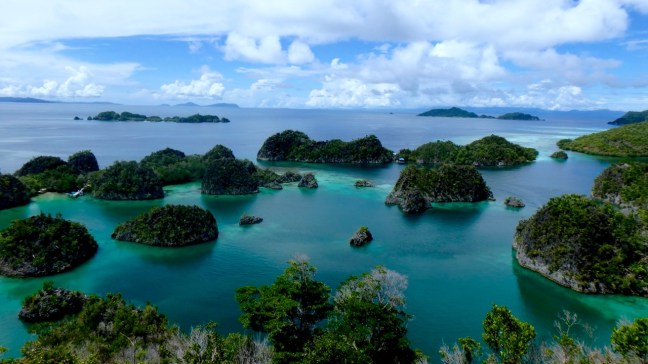
Two flights, a 3-hour rusty ferry crossing and a 1.5 hour rickety longboat ride in the darkness of the falling night and we arrive to the lost paradise of Raja Ampat, West Papua. Once part of the Australian land mass, West Papua is the Indonesian side of the island of New Guinea, one of the least populated provinces of Indonesia. Off the Western coast sits the Raja Ampat archipelago, a cluster of over 1,000 islands home to the richest marine biodiversity of our planet.
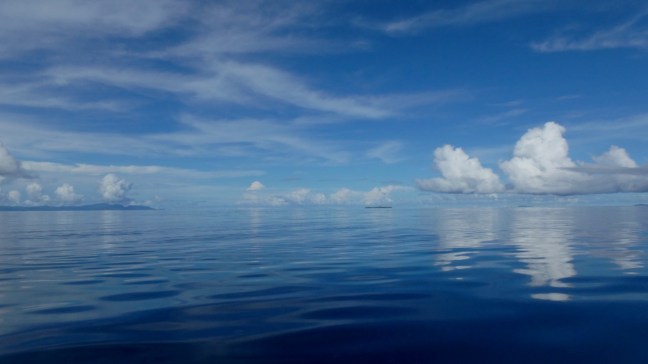
Wild, untouched and forgotten by civilization, the natural beauty of this virgin archipelago goes far beyond what I can attempt to describe. Off the beaten track, light years away from any commodities of the developed world and unpopulated except for scattered local families that inhabit lost villages, hidden bays, white sand stretches and the dramatic cliffs of the islands’ rugged coastlines. Raja Ampat emulates how Planet Earth must have been before humankind got into the equation.
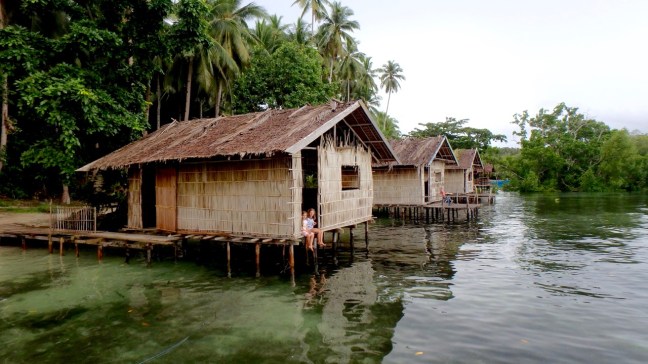
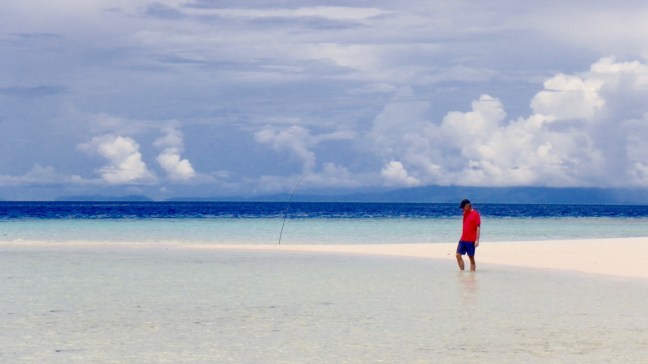
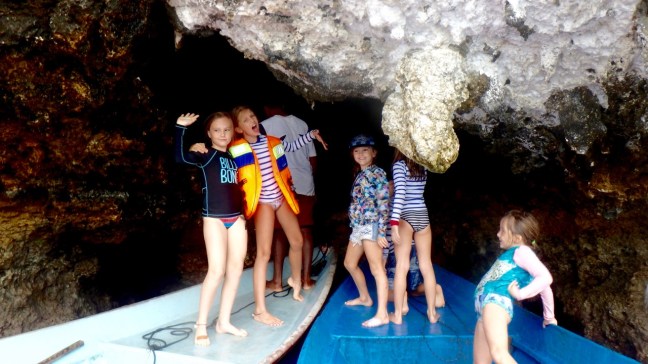
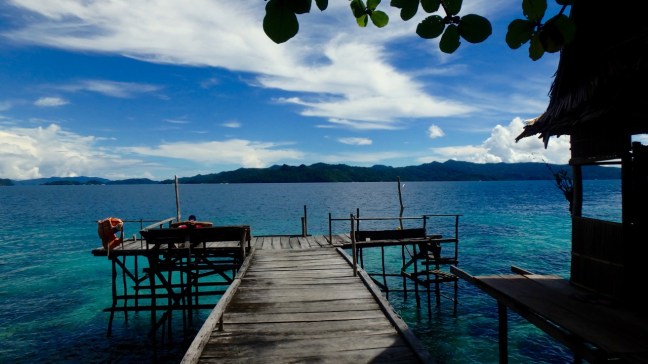
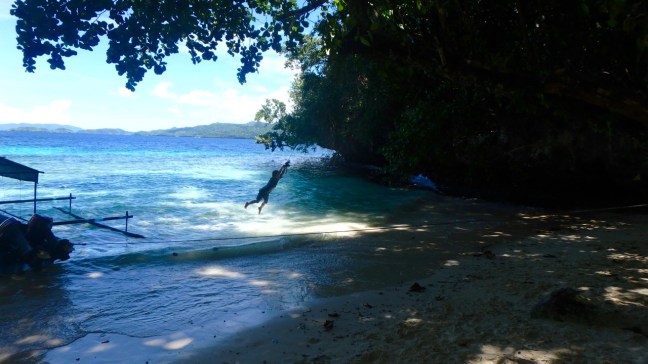
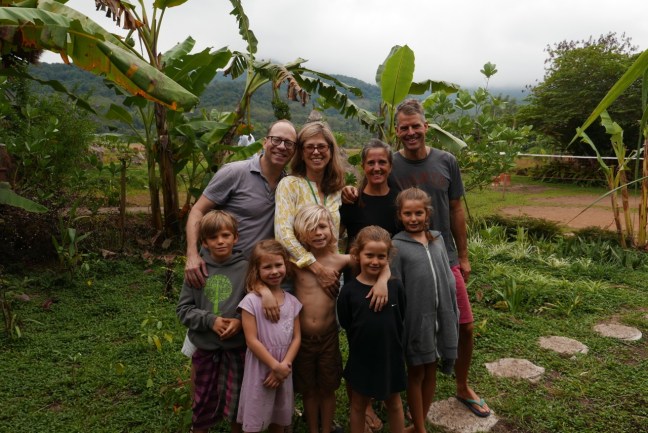
Along with our dear friends the Nolans, whom at the last minute and much to our delight decide to join us, we “settle” in the island of Gam. Our days of simple living “à la Robinson Crusoe” in our rustic cabins over the sea, slowly flow amidst fluorescent turquoise crystal clear waters. Fishing, well… sort of… -all we can find are a few rusty hooks and some fishing line (no bait, of course!)-, day trips to blinding white sand beaches, a whole lot of exploring the wonders of the underwater world and the most spectacular scenery I have ever admired become our routine and we are loving it.
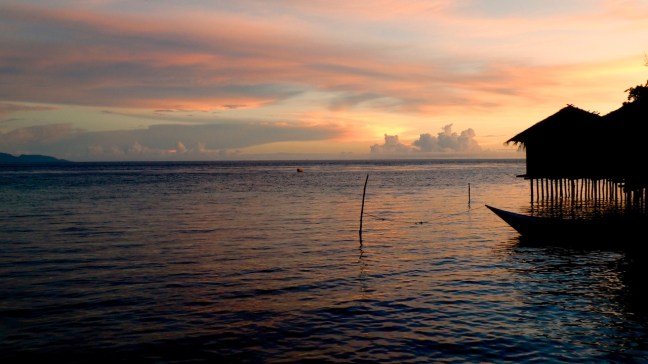
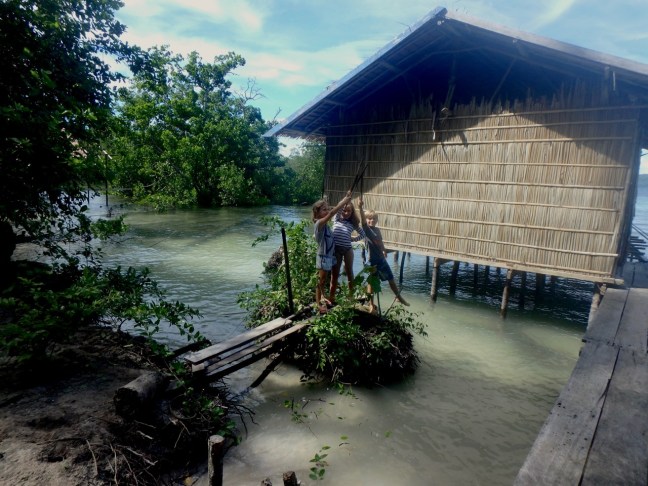
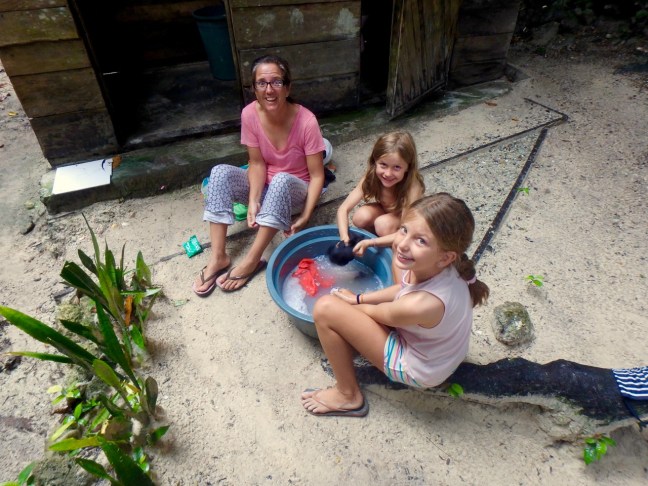
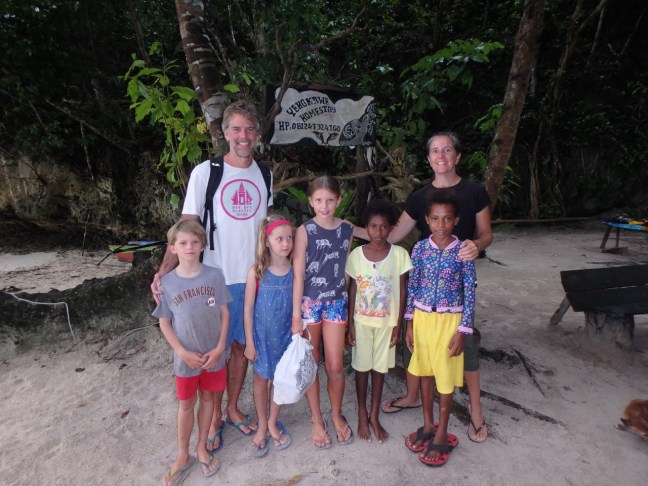
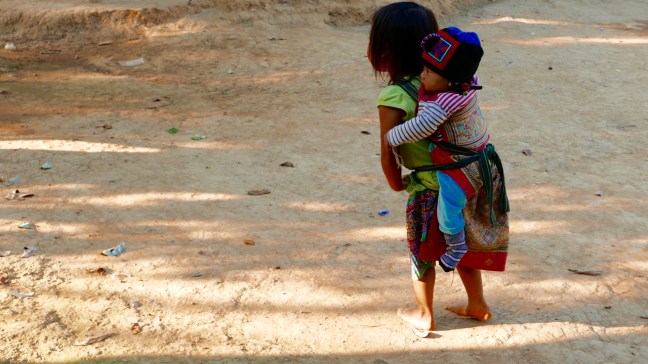
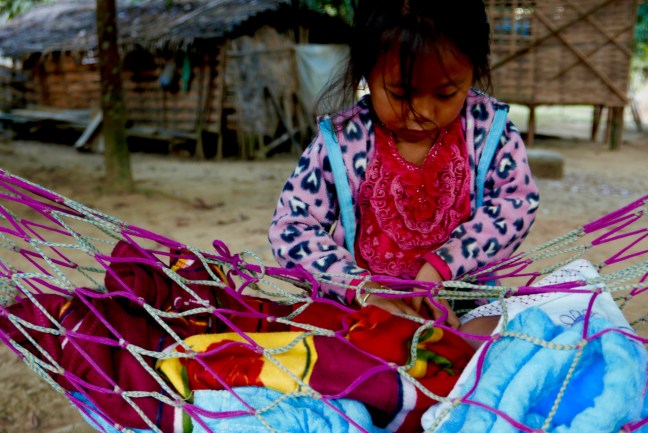
In Waigeo, the next island that we call home, a native family takes us in and hosts us in their modest straw huts rudimentary built on stilts over the pristine waters. Their warm smiles and very broken English combined with our limited Bahasa skills, make for many good laughs for all. Being lost in translation is the new normal but everything has a way of always working itself out.
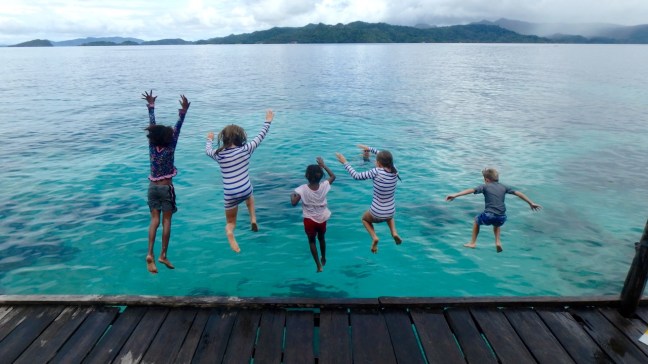
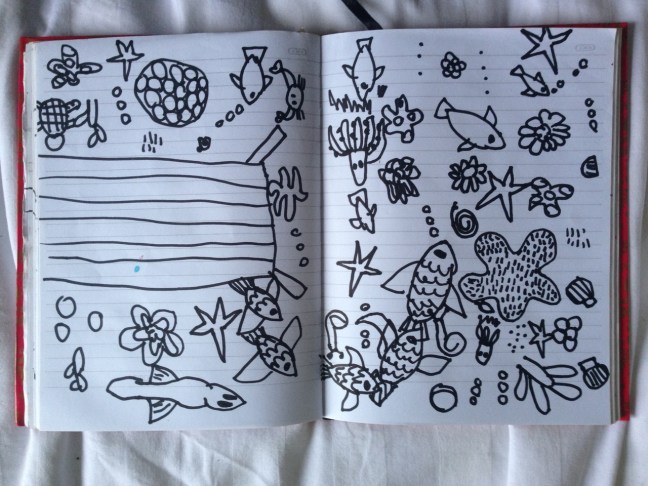
Jumping off the jetty into gardens of shockingly colorful coral and countless fish becomes a favorite pastime. Big and small, striped, polka dotted, long and narrow, short and stout, smooth or spiky… we spend the days admiring the most spectacular, abundant, bizarre-looking and fascinating underwater creatures, unimaginable even to the most creative minds. We dive into the world of water snakes, crocodile fish and nudibranchs that among an infinite variety of fish, become our swimming companions. We just cannot get enough of it…
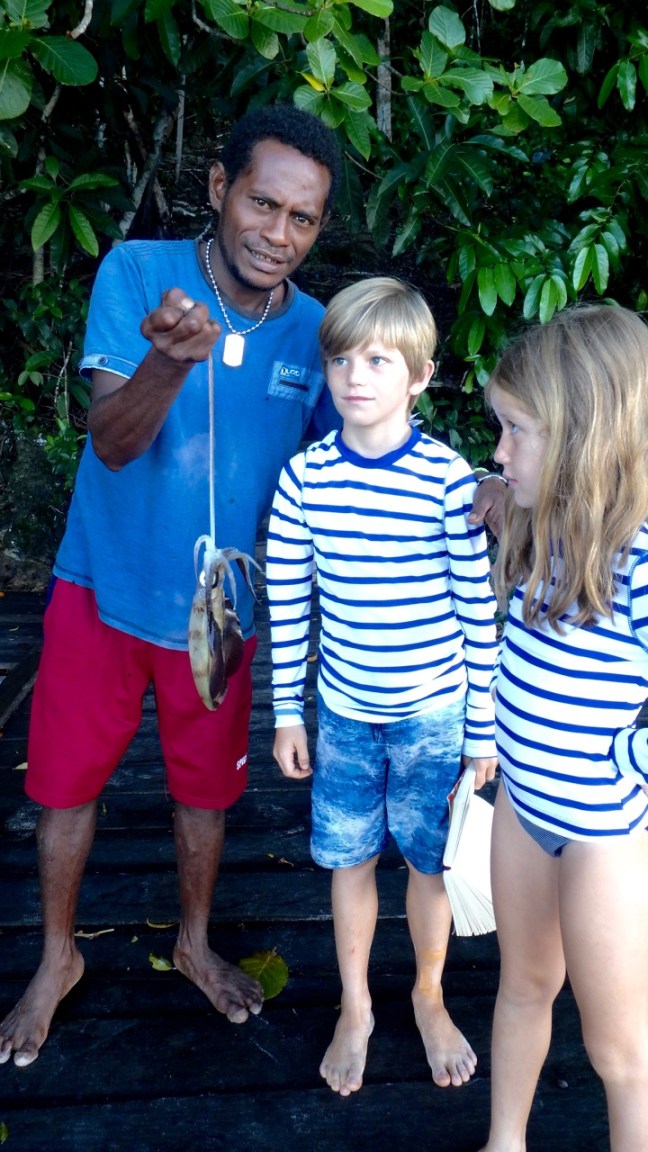
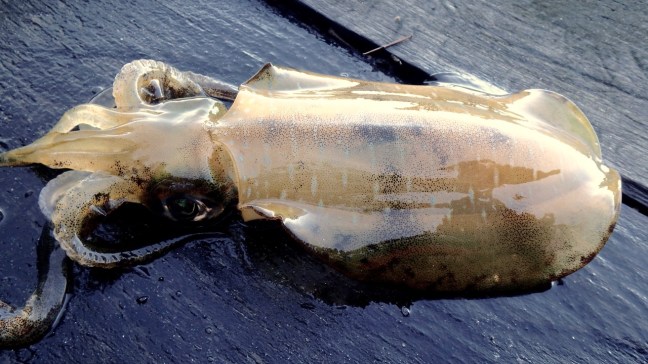
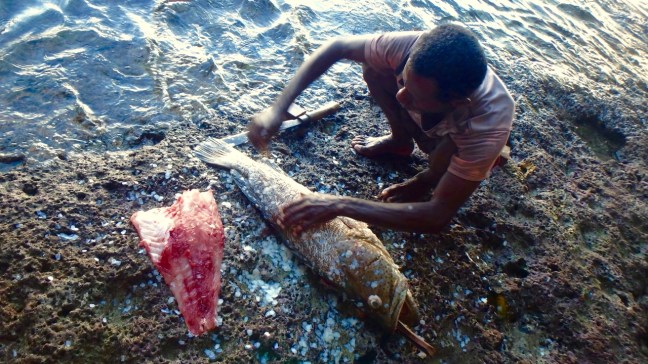
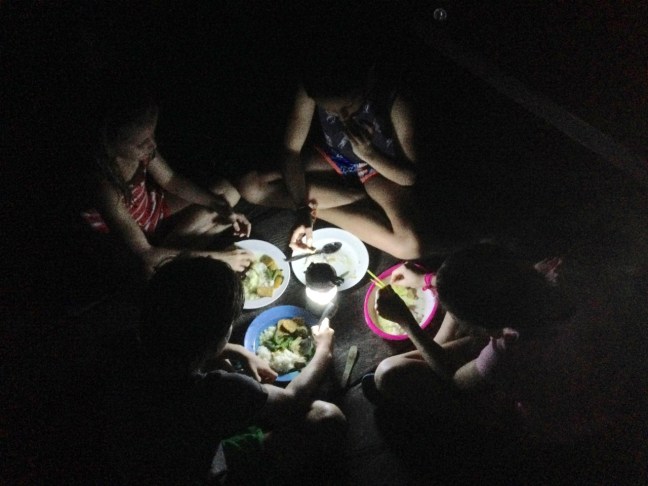
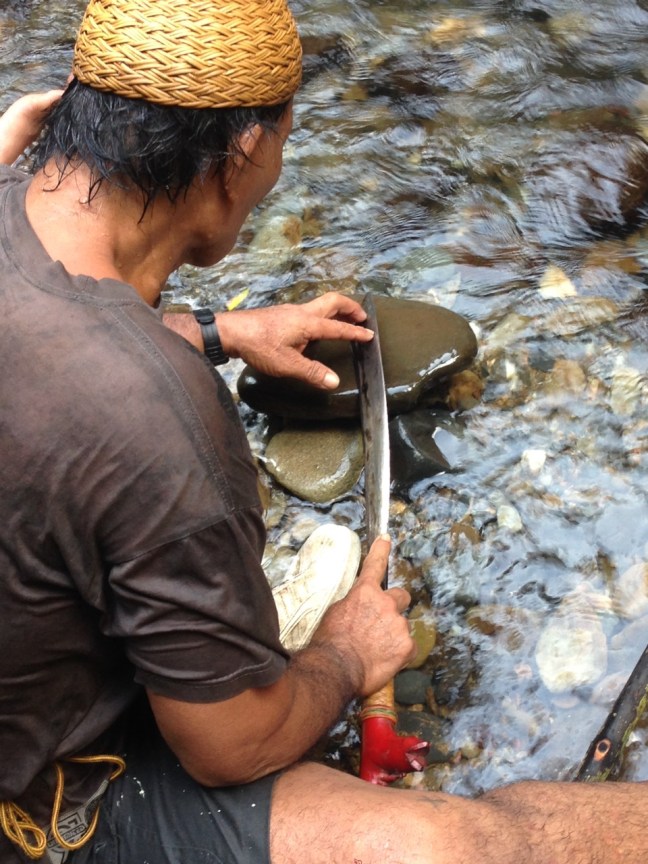
The up to 10 kilo fresh catch of the day, along with some rice and dark green vegetables, becomes our daily menu for lunch and dinner -breakfast is an unknown concept… oh, well…-. Much to our admiration Pak Daniel, the eldest of the clan, skillfully descales, slices and prepares the fish with pride. Machete in hand and squatting over the rocks by the shore, the coming and going of the low tidal waves help him with the final cleaning. Meanwhile, the kids’ morning pastime is throwing other smaller fish back into the shallow waters only to try to re-catch them with their bare hands.
By the end of our stay, fresh fish, green leafy vegetables and rice taste delicious no more… we have fantasies of fresh, crunchy, colorful, tasty salads and fruits… It is time to go. Where next?


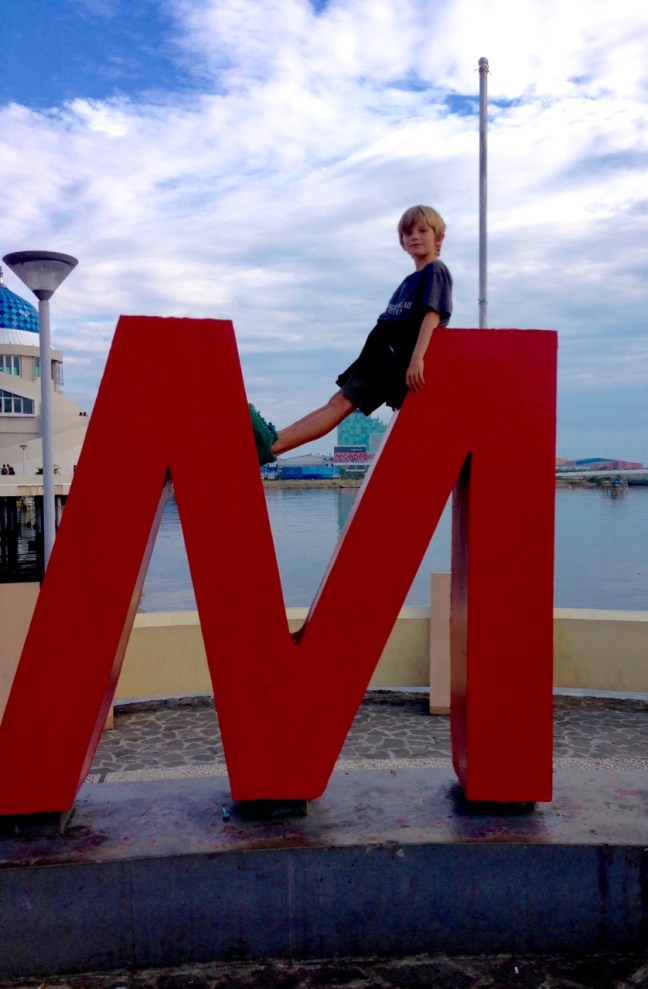
Our next stop is Makassar, capital of Sulawesi, one of Indonesia’s largest islands. Peculiar in shape, and limited in connecting urban infrastructure, much of Sulawesi has been able to remain relatively untouched by the outside world. Although mostly muslim, Christian communities and pockets of natives loyal to local beliefs and deities are not uncommon findings throughout the island.
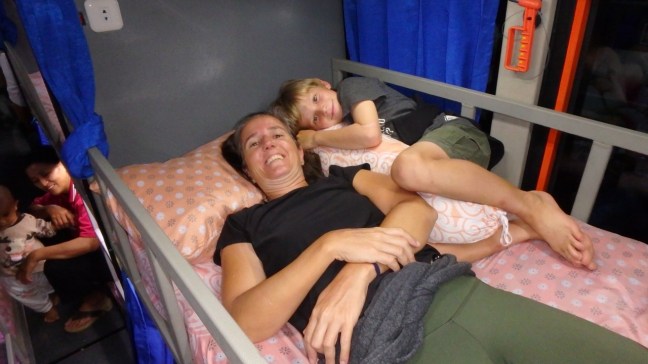
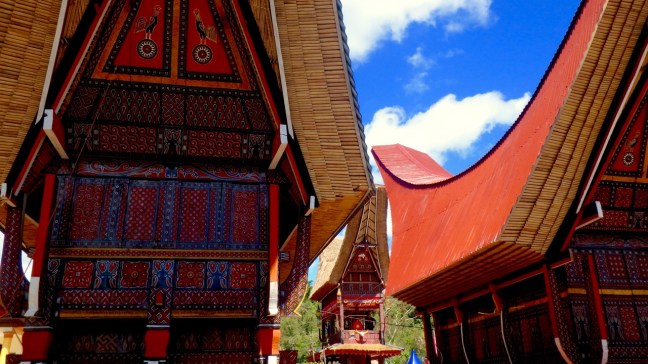
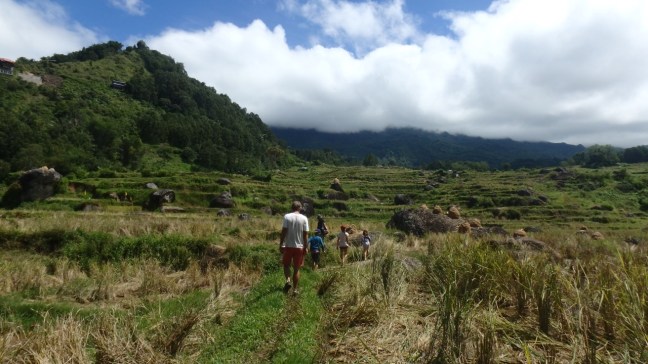
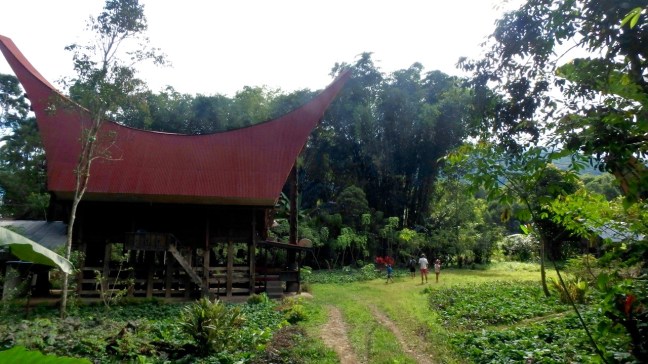
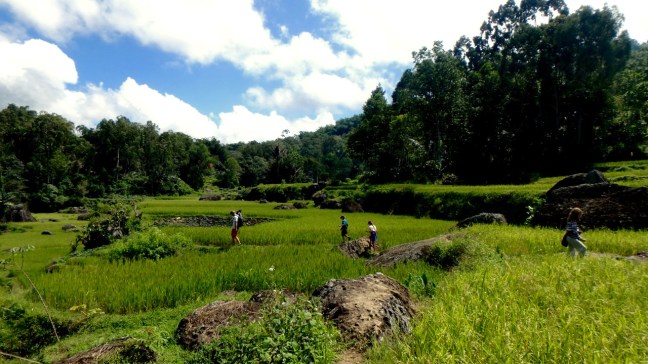
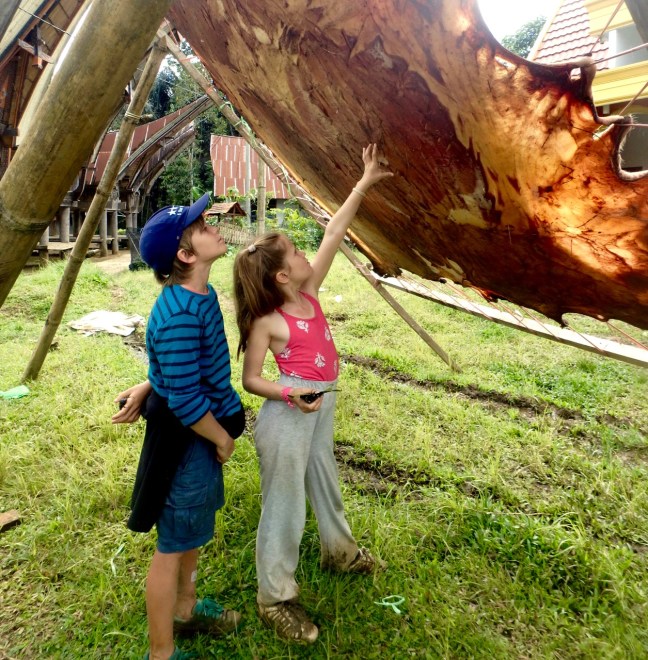
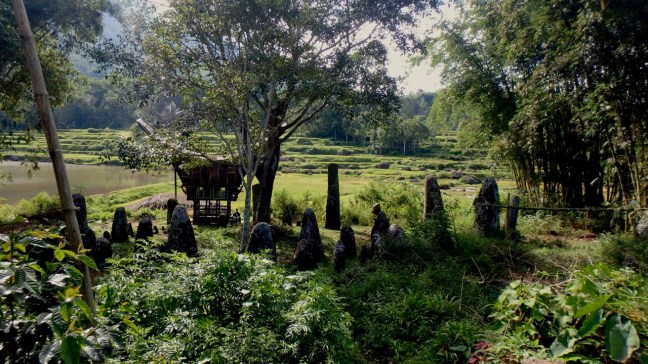
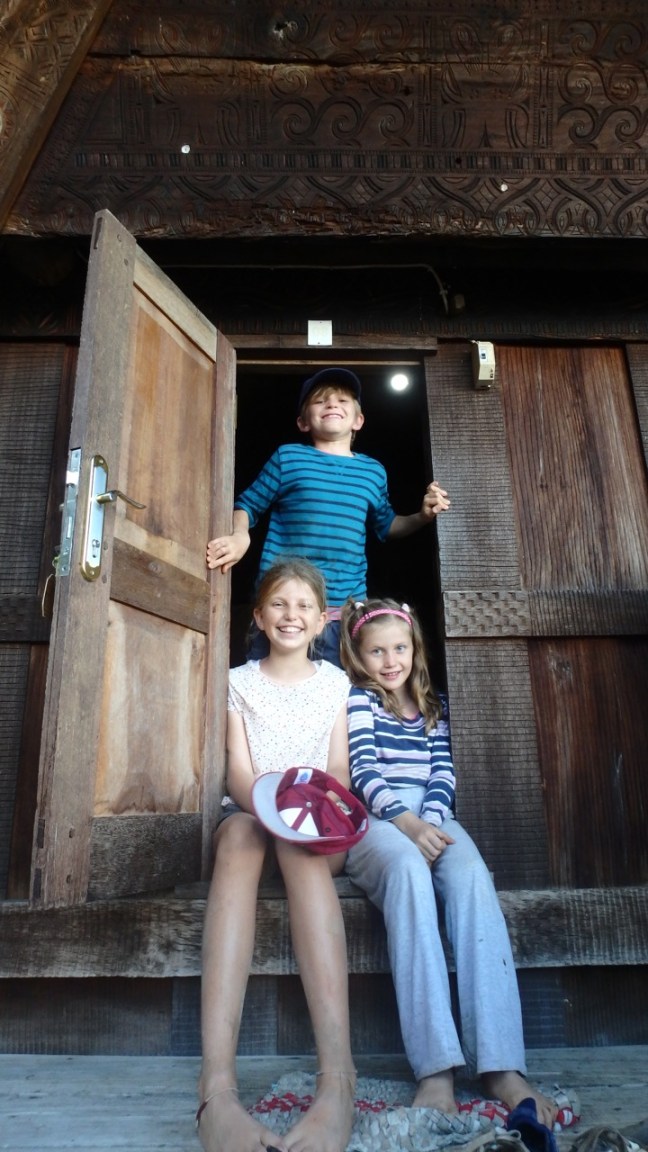
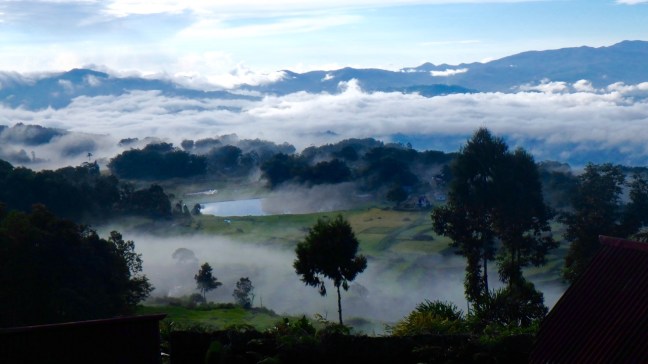
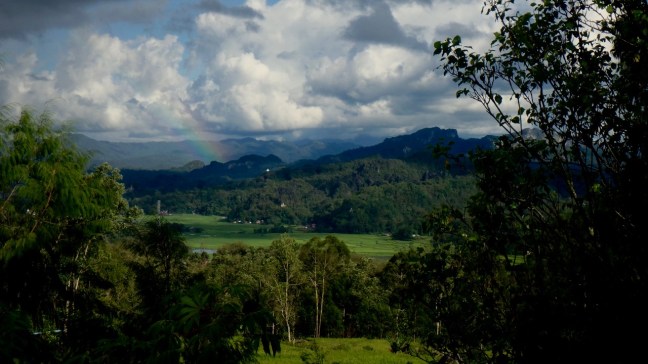
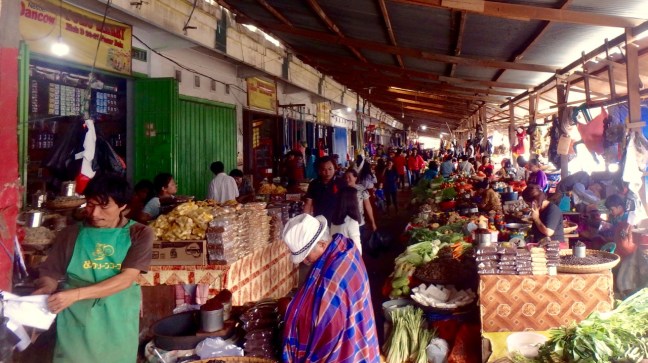
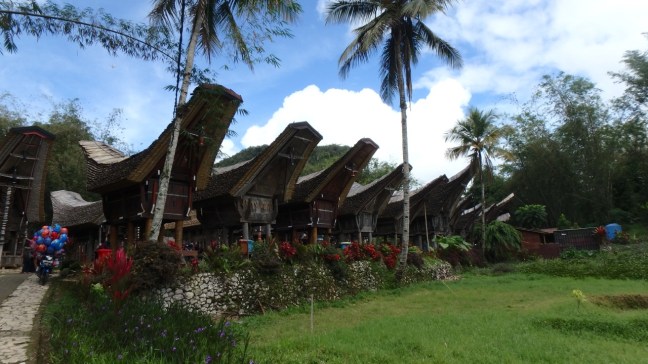
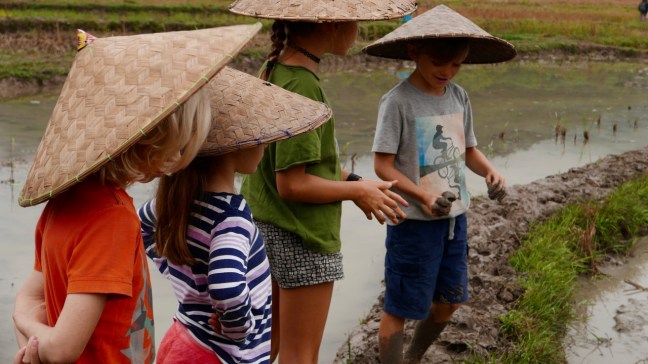
From Makassar, an overnight-loooong-jerky-hilly-windy-bumpy-stormy bus ride -Marcus may hold the title for Vomiting World Champ and we may hold the one for the Most Unprepared Parents of the Year… I will leave the details to the imagination- takes us to the mountains of Toraja. Traditional villages, characteristic for their Tongkonan silos and homes reminiscent of boats, scatter throughout Toraja’s topography of remote valleys, beautiful mountains and impossibly green riced terraces sprinkled with dark colored boulders. Our base camp is in Rantepao, Toraja’s capital, a lively town that grows on us as we slowly discover it and make it our own.
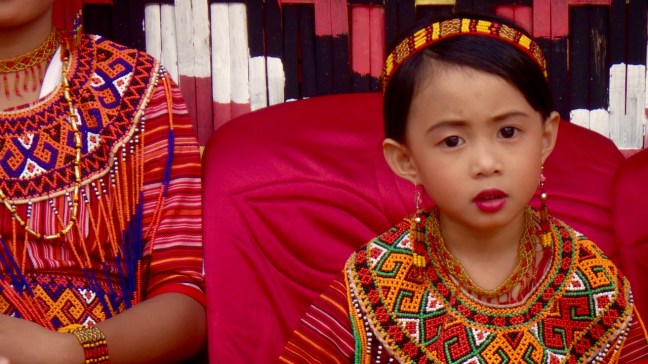
Torajan culture is rich and its traditions plentiful. Although Christian by legacy of Dutch colonialism, Torajan people have managed to preserve their ancestral animist Aluk To Dolo, or Way Of The Ancestors, beliefs from generation to generation. The result offers a unique, if not bizarre, and captivating combination of rituals and ceremonies unlike anything we have ever experienced.
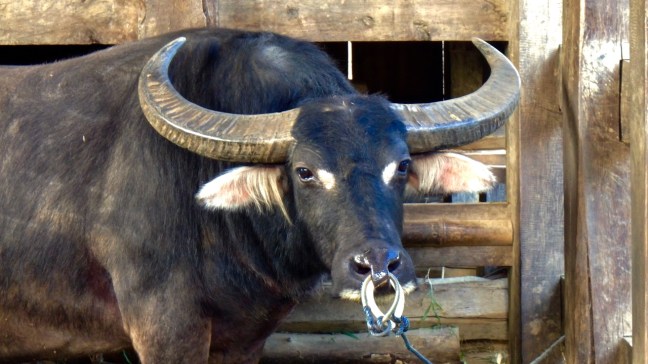
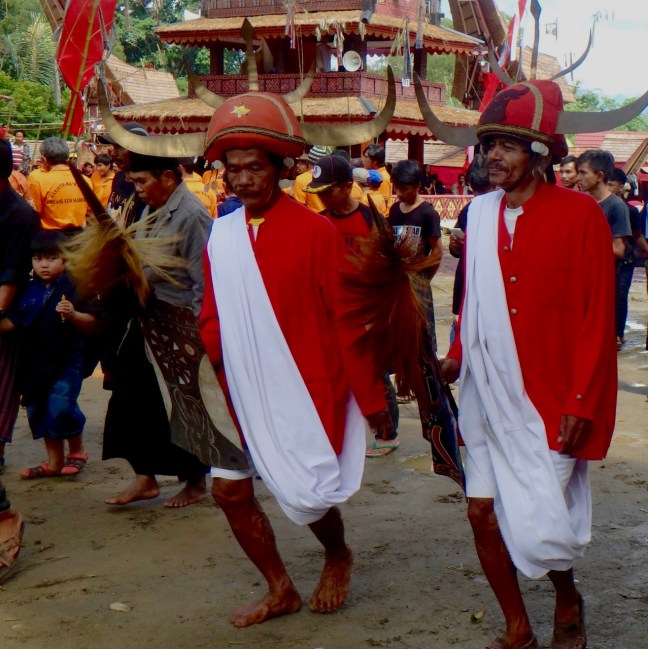
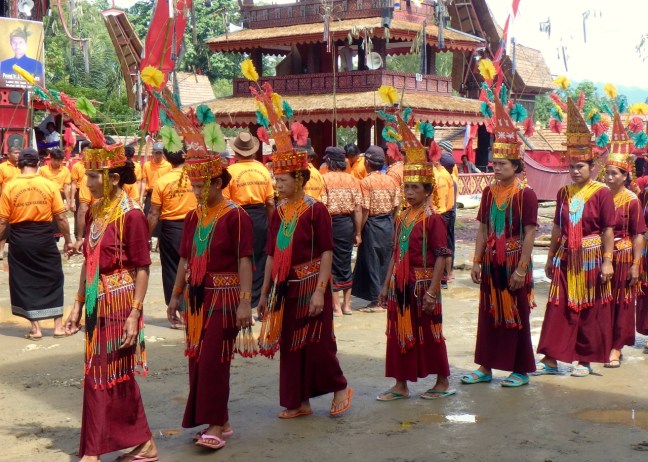
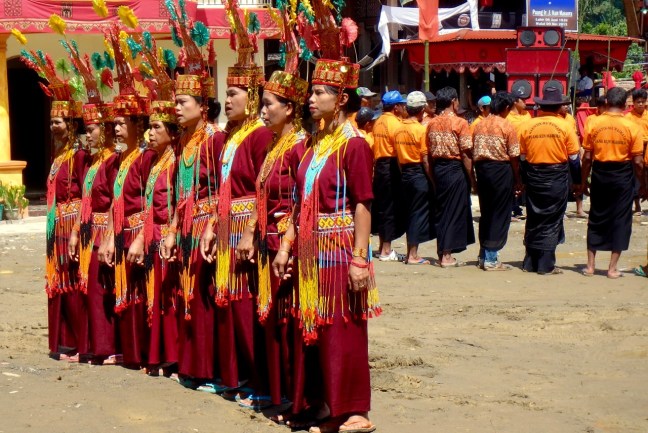
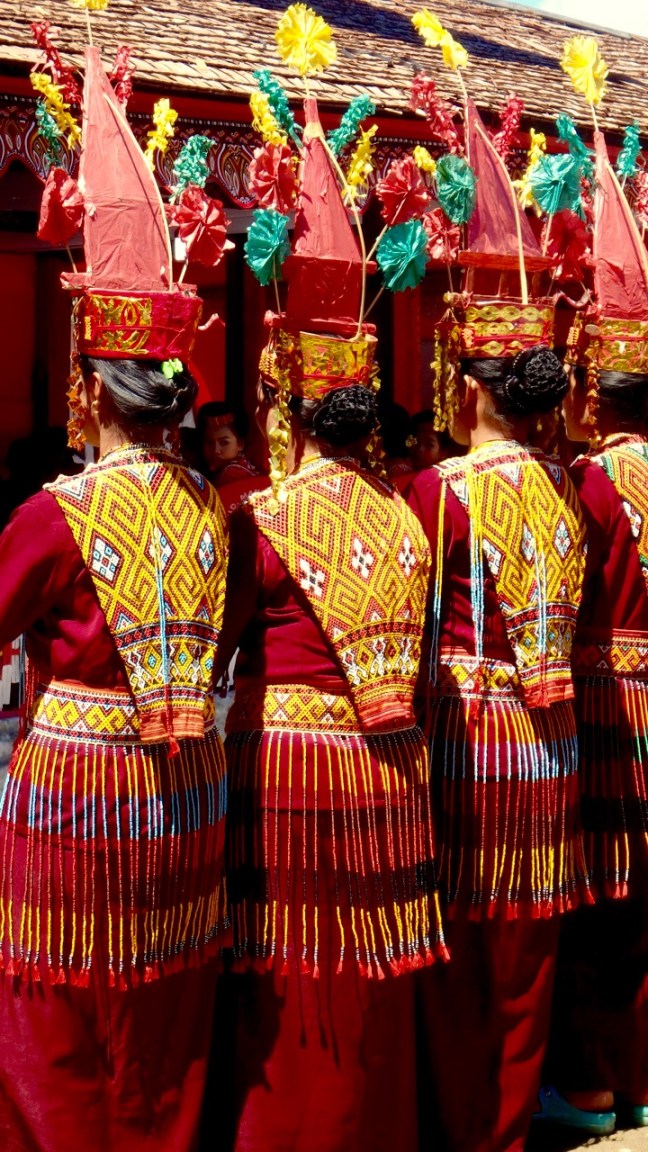
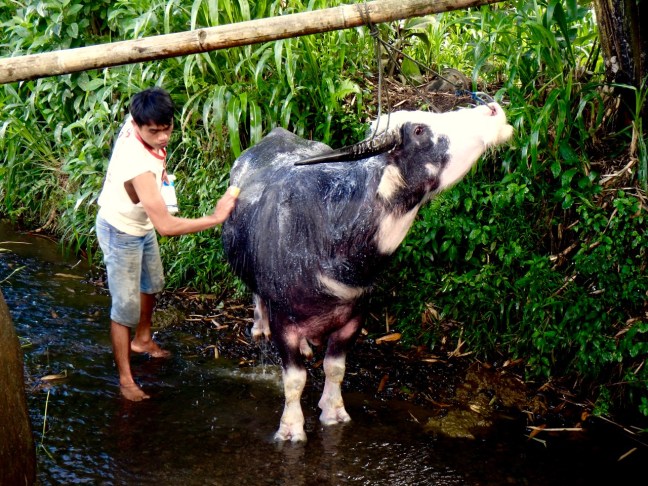
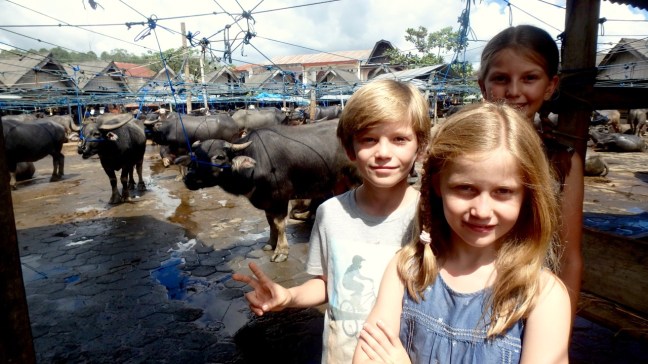
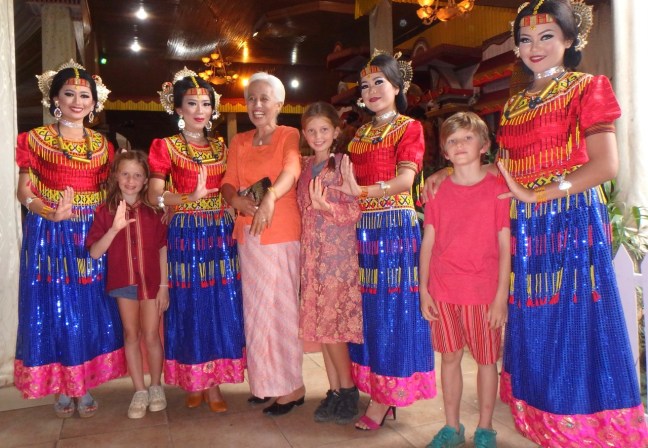
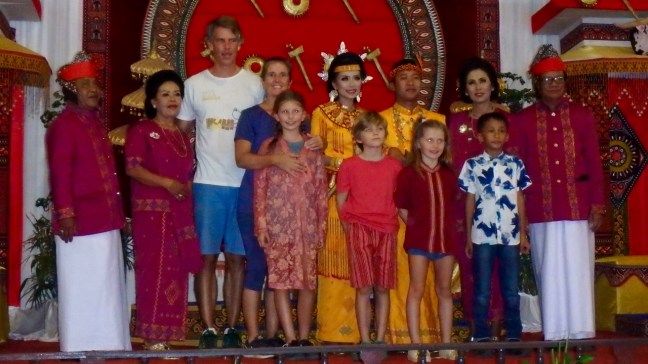
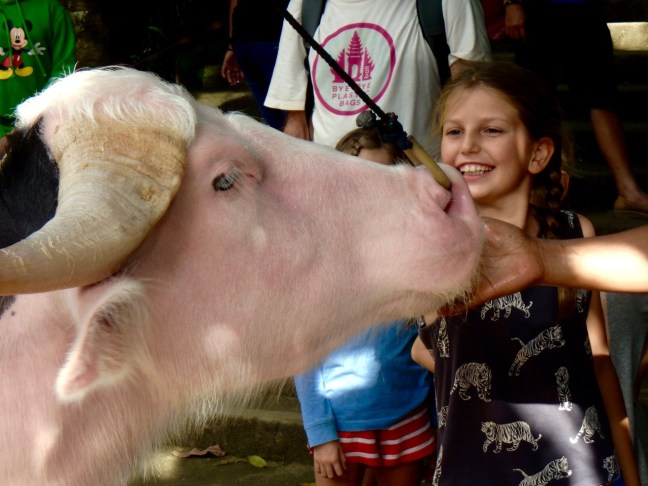
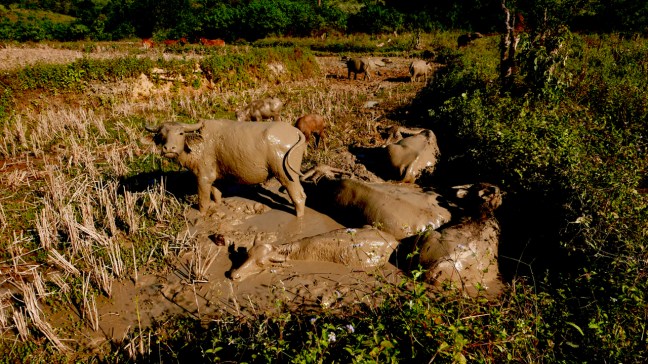
Torajans worship, prepare for and celebrate death on a daily basis. Unknowingly, we are lucky enough to land in Toraja in the midst of Funeral Season (ignorance is bliss!) so, faster than we can say cheese, we find ourselves immersed in a paramount funeral of a wealthy man who died… two years prior! Torajans are not in a hurry to bury their dead. Instead they live with them and take their time until all is aligned and in agreement for the multi-day long rituals and festivities to start: majestic buffalo are presented as gifts to the family of the deceased, offerings of slaughtered animals butchered with scientific precision by the collaborative efforts of barefoot villagers lay in a pool of blood over the naked soil, dancers in traditional beaded ropes parade to the rhythms of ancient chanting and a whole lot of intricate protocol unfolds to welcome the guests of these highly hierarchical society.
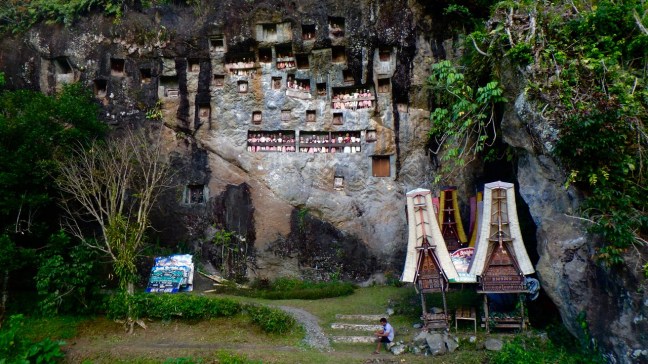
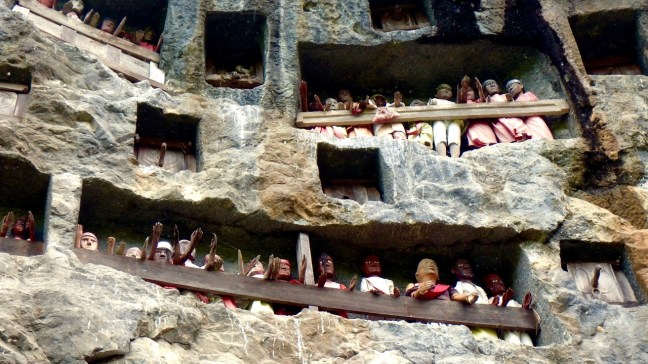
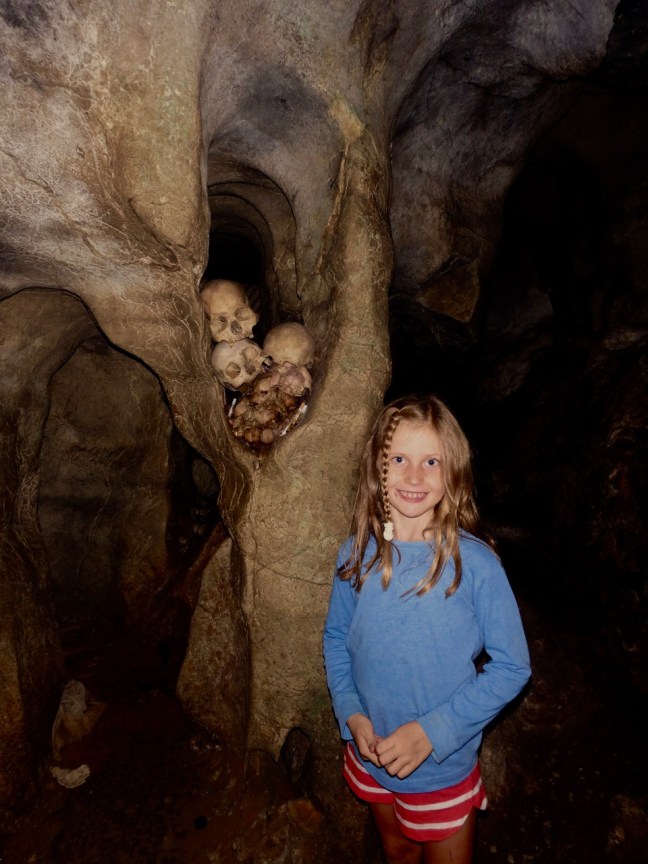
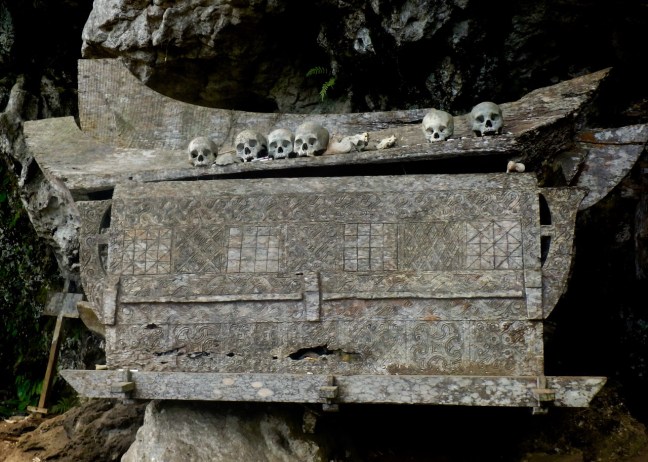
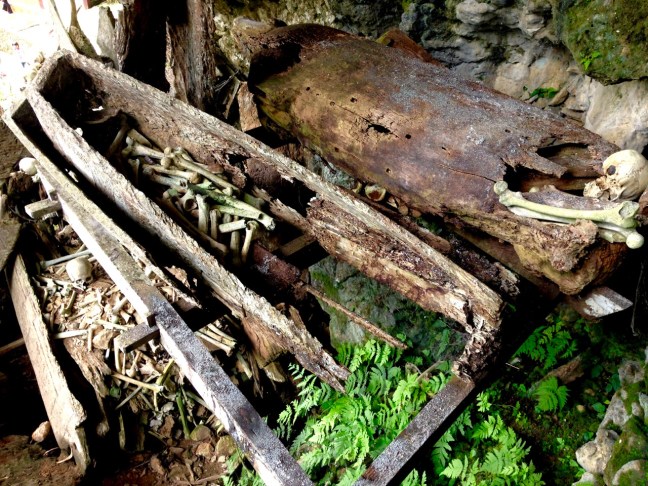
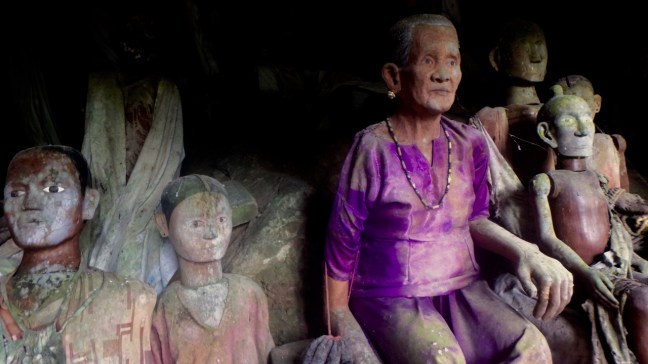
We explore the burial sites of Lemo, carved high up into the rock walls of the hills, and the Caves of Lomba. Connected through a nature-made network of long, narrow tunnels deep inside the rock walls of the cliffs, the Lomba caves are the haven for the privileged bones and dilapidated caskets worthy of such honor. Outside the caves, their homonymic “Tau-tau”, wooden, real-size sculpted depictions of the deceased, keep them safe under an eagle watch.
We embark on a two day hiking journey with our trusty local guides, Pak Budi and his son Atto, who gift us with his wisdom, genuinely friendly demeanor and quirky sense of humor. Along the mountainous terrain, we are welcomed by the local people who seem amused and fascinated by our unusual western ways and looks. Inspite of their simple life and limited resources, the locals generously open their homes to us and expose a glimpse of village life much to our delight.
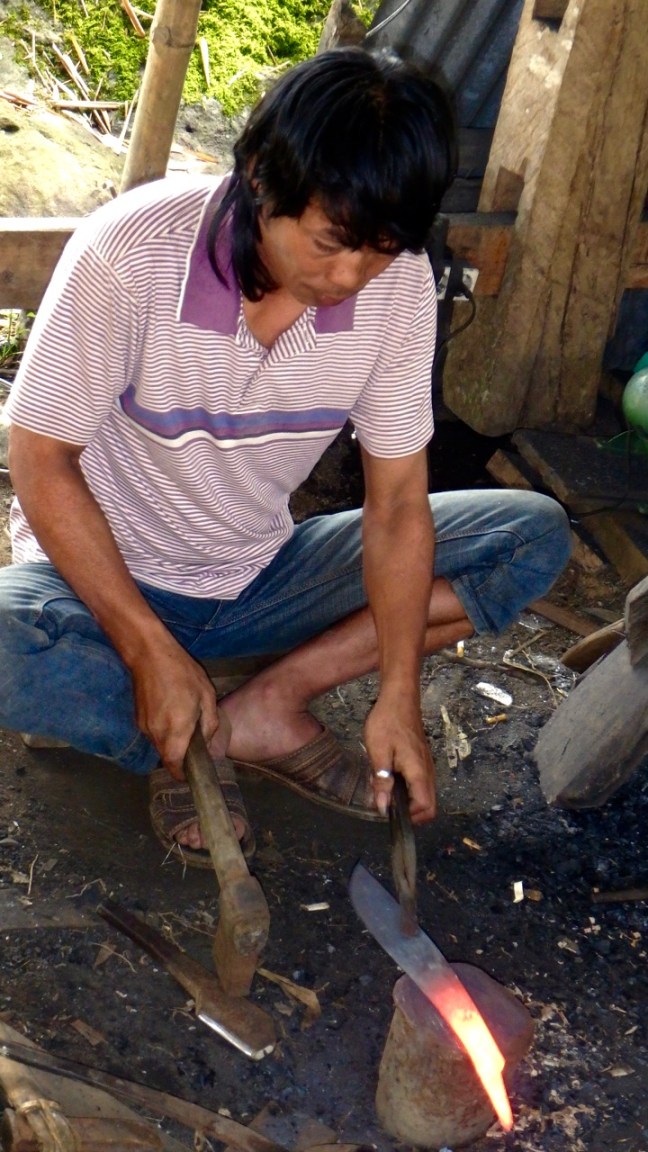
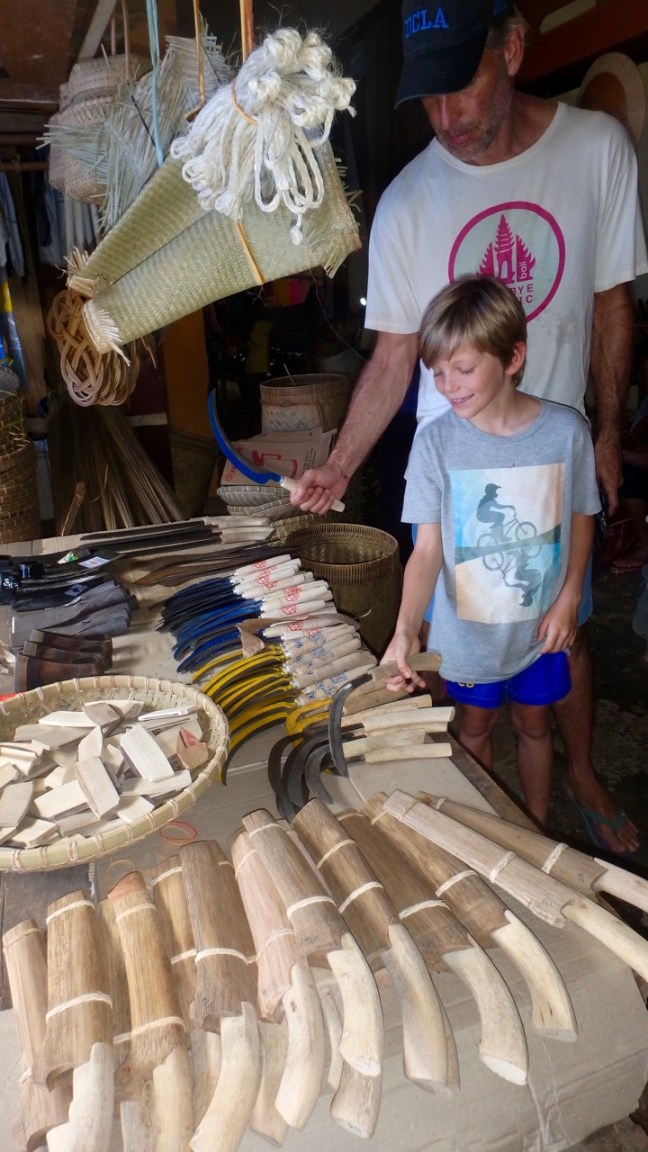
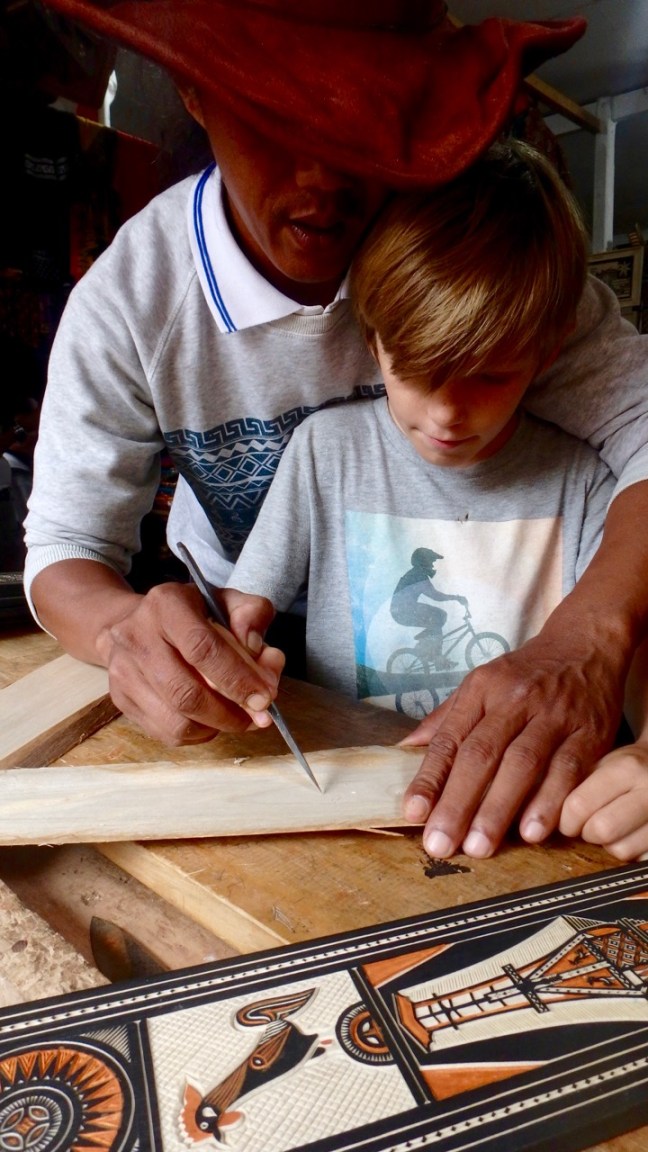
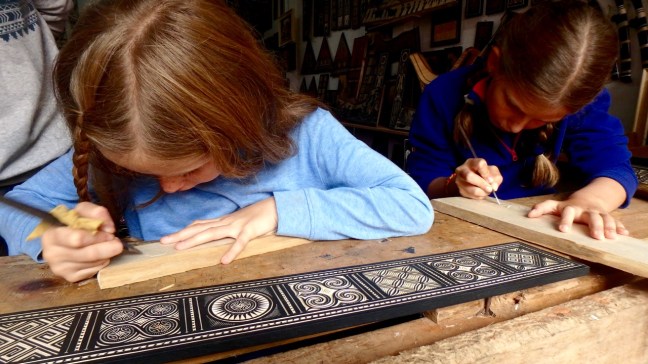
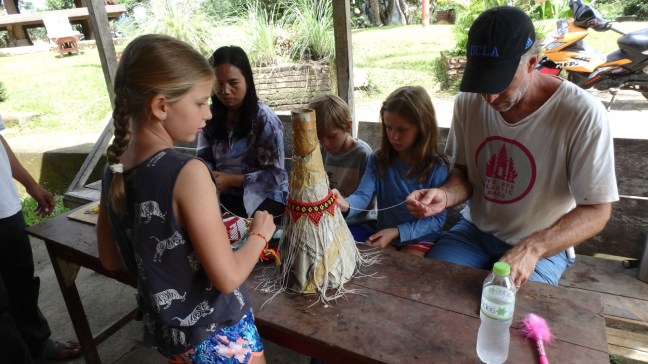
Torajan people are remarkably skilled and incredibly talented artisans and they patiently teach us their arts. In Ketc’Kesu we practice using rudimentary carving knives and learn to paint intricate Torajan motifs with the experts, and back in Lemo, Ibu Marion teaches us the art of beading delicate filigrees, one bead at-a-time. We have learned so much… we leave Toraja feeling grateful for its unprecedented natural beauty, thankful for its gentle-mannered and generous people and fulfilled by this rich culture full of art and meaningful traditions.




We have a whole lot of time and what feels like endless freedom so off we go, over the Indonesian skies, to the island of Java.
Home to more than 50% of Indonesia’s inhabitants, Jawa Timur or Java, is the most populated island in the world. Neighbor to Bali to the East, Java dominates Indonesia politically, economically and culturally. Much of Indonesia’s history has been written here: Hindu and Buddhist empires, Islamic sultanates, the heart of Dutch colonialism and the epicenter of Indonesia’s independence in the 30’s and 40’s.
We land in Surabaya, East Java’s metropolis, and through trial and error we manage to catch a local bus to Malang, a smaller, friendlier, more manageable city, two hours south. Once in Malang we plot our next adventure. Exploring the magnificent volcanoes of East Java: Mount Bromo and the Ijen Plateau.
Our new local hire, Pak Widodo, will kindly, patiently and (mostly) safely navigate the traffic of what seems like infinite, monotonous and busy roads filled non-stop on either side by building after building of any business imaginable. Inhabited by a majority of muslim population, the domes of the mosques stand bright above everything else adding splashes of contrast and sparkle to the blue skies.
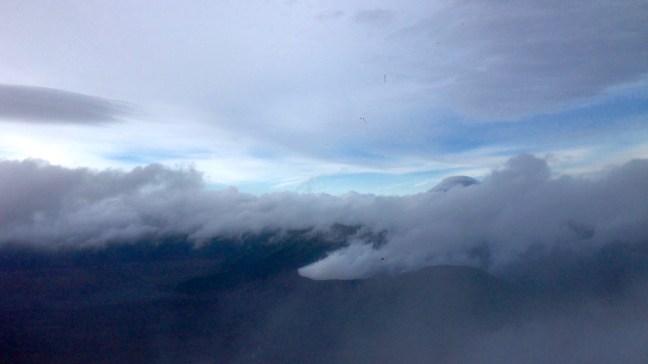
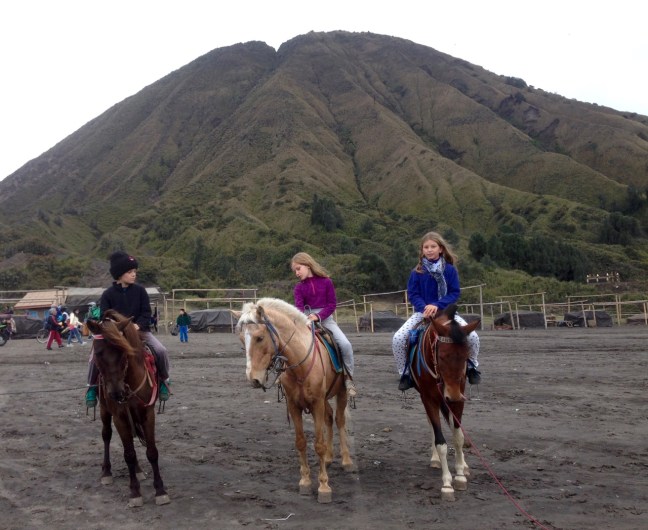
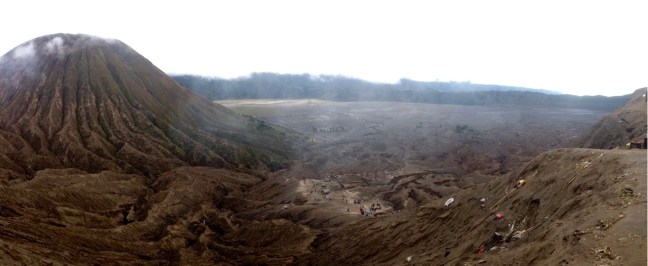
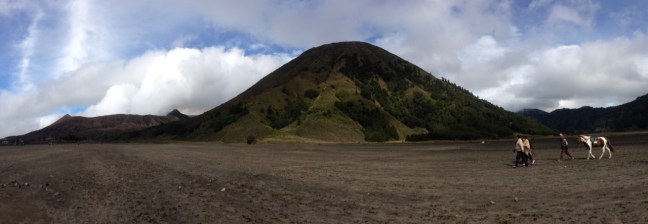
From a deep green valley up a steep mountain road we drive to the small town of Cemoro Lawang, gateway to the magnificent and smoking crater of Mount Bromo. A hike around town gifts us with the most striking first glimpse of the volcanoes. In the foreground, as if dressed in a soft silk tunic, stands Mount Batok. Beside it, Mount Bromo’s smoking crater. In the distance mounts Kursi and Widodaren, all swimming in what is known as the Sea of Sand plateau, a vast, bare, sandy “ocean”. The magic of such beauty is exhilarating and hypnotic. The combination of textures, shapes and scale, the warm sunset light that showers the scenery changing the spectacle every moment… It is entrancing. We can’t wait to conquer the volcanos.
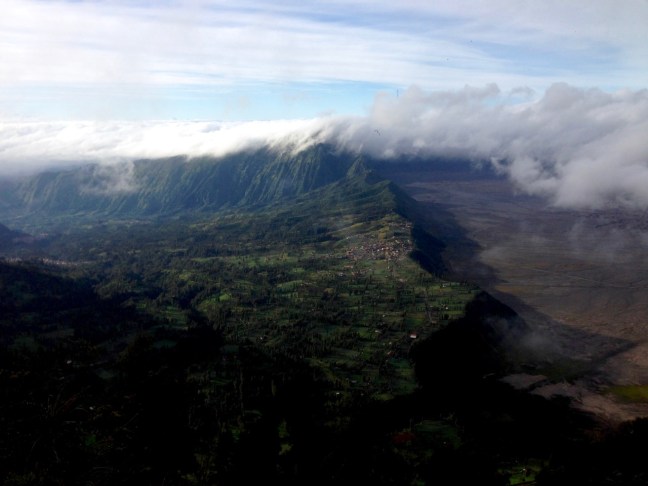
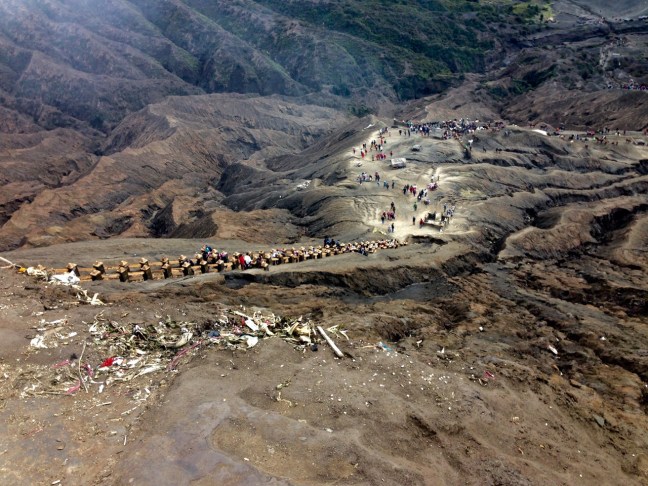
That night, an old blue Jeep that still roars strong drives us up, high above the canopy, to the mountains across Mount Bromo where we patiently await for the sunrise. The cold is intense and the fog is thick but patience and perseverance pay off and when the sky opens up my eyes fill up with tears of gratitude for the beauty that unfolds in front of me. Like a heavy blanket keeping you snug, the fog unrolls to uncover a stunning lush valley. At the edge of it, the Sea of Sand surrounds Bromo’s active crater and Batok’s majestic presence. We forget all about the cold, we forget all about the 3:00 am wake up call, we feel -we are!- on top of the world! Later, sitting on the ridge of Bromo’s smoking crater, we hear the Earth’s core roar; mightily, passionately, intensely, fiercely…


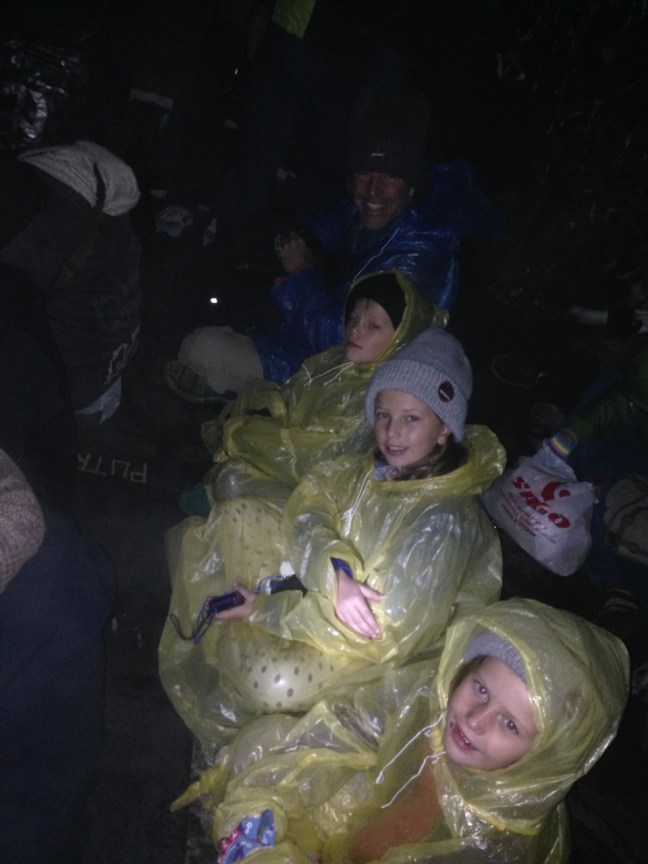

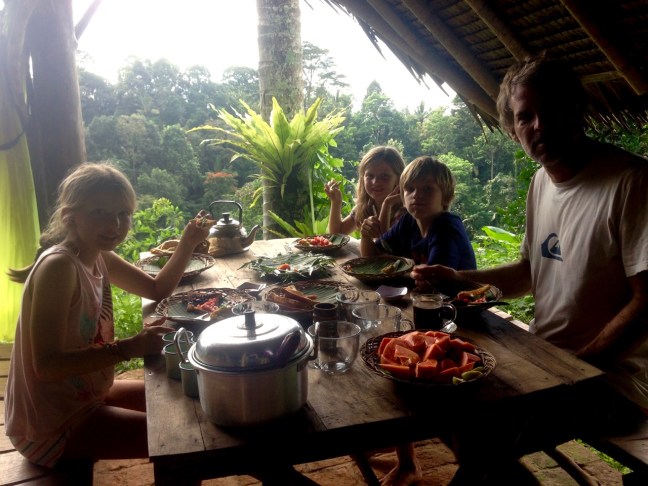
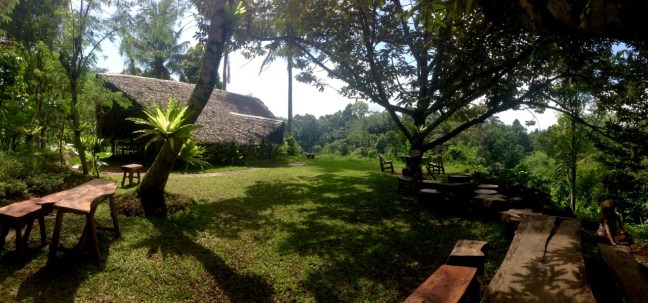
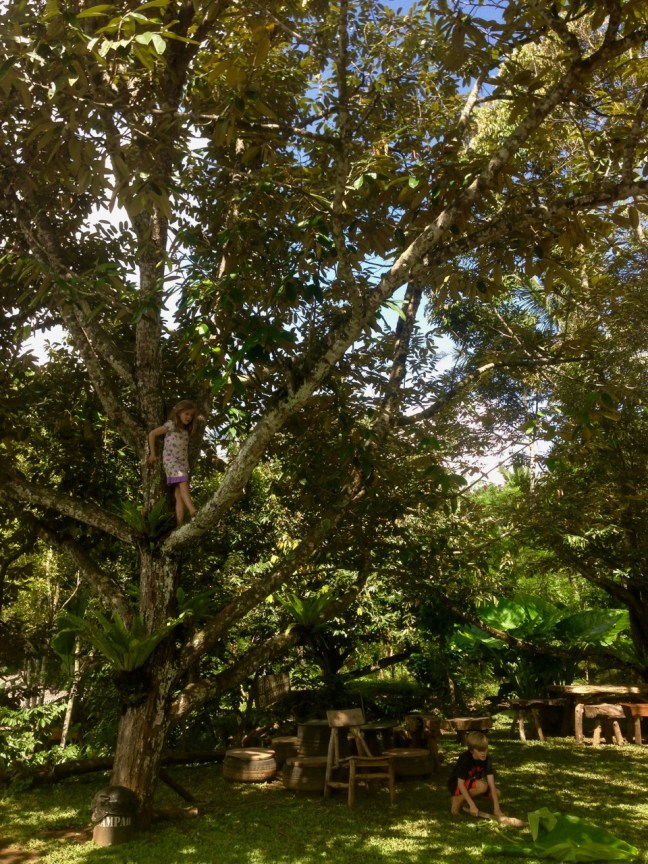
A long… long… long drive through dryer landscapes of bushes and deciduous trees, followed by bright green rice fields, coastal towns of calm bay seas, a huge coal plant -supplier of Bali’s electricity-, lush forests, coffee plantations and scattered palm trees and we arrive to the jungle. The road keeps on getting narrower, narrower and narrower and in the dark of the night we have finally make it to the tiny village of Licin, our new home town from where we will venture to explore the Ijen Plateau. A full day of rest to play, relax, read, write, draw, climb trees and watch the jungle go by is a must in preparation for the 12:30 am brutal wake up call the following day. Ijen, here we come!
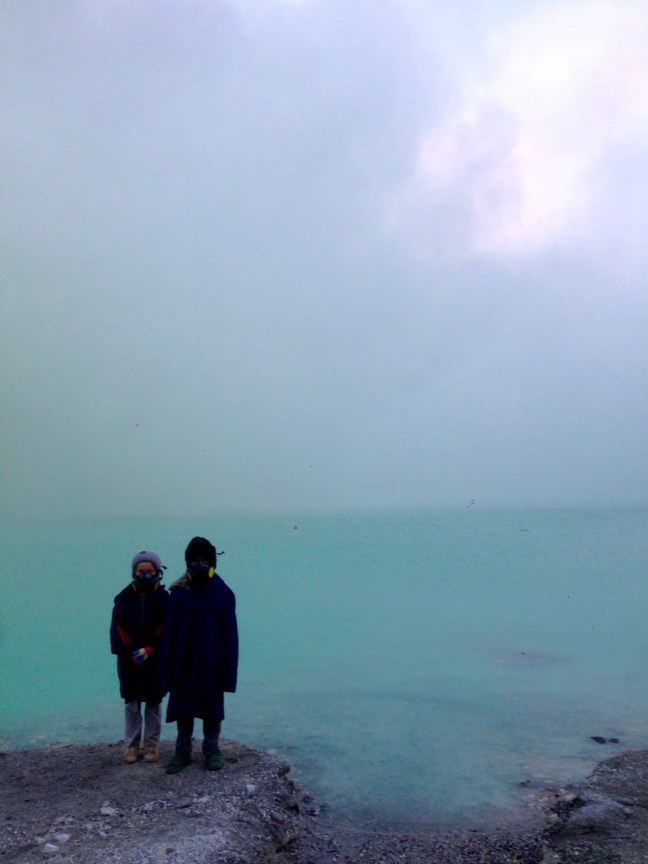
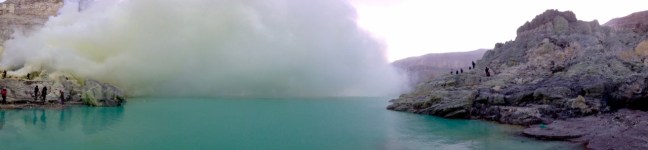
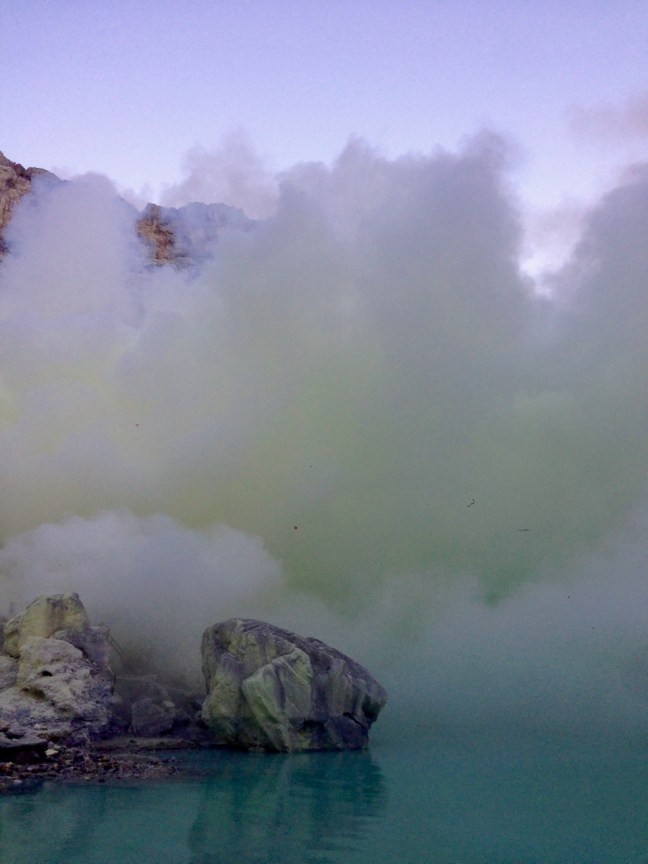
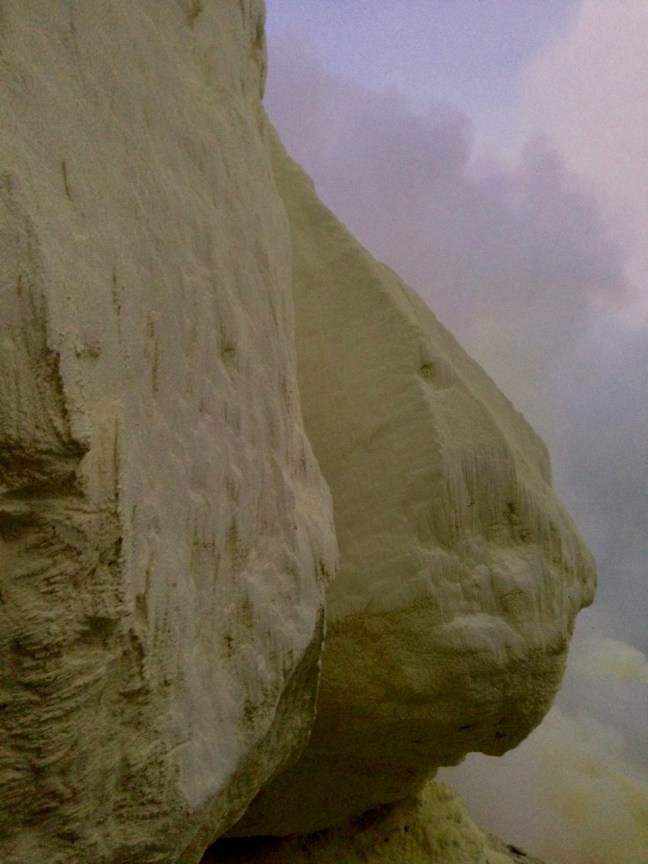
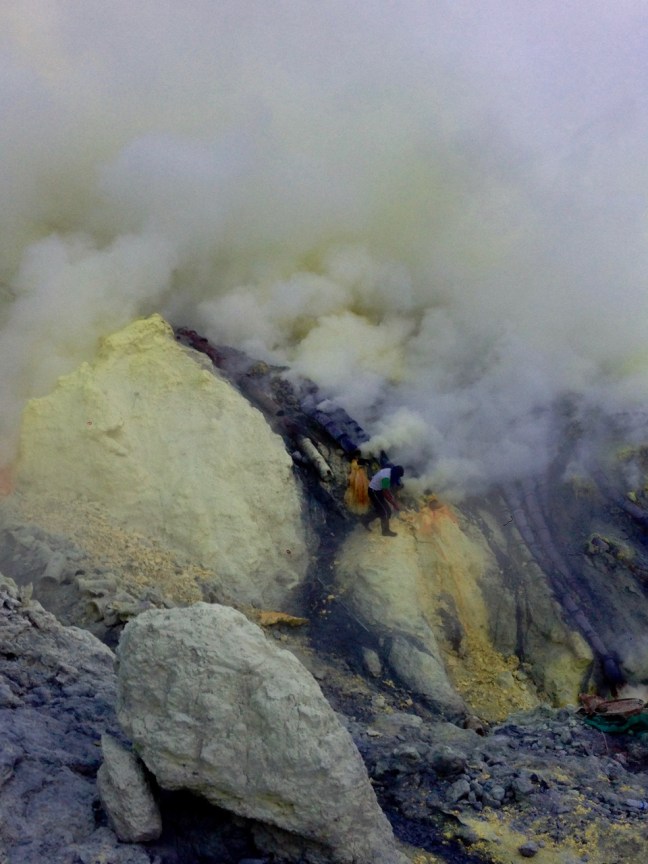
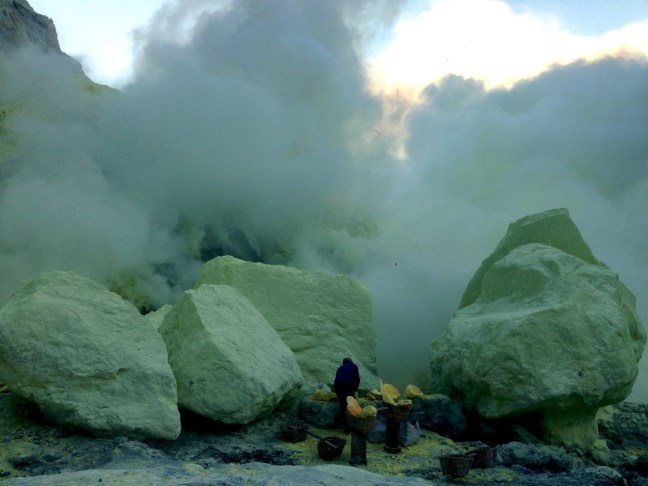
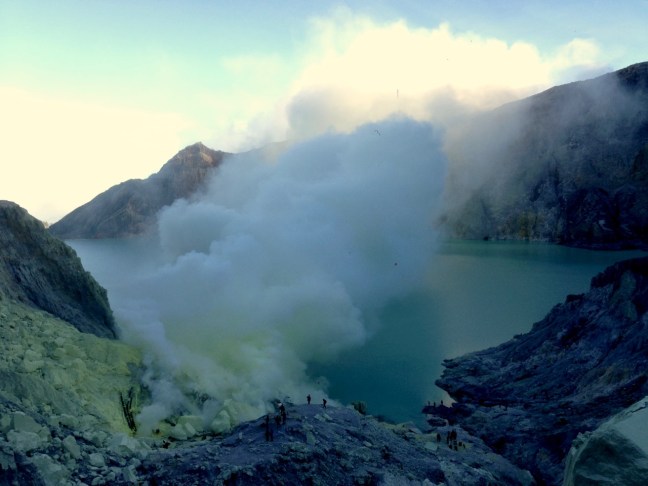
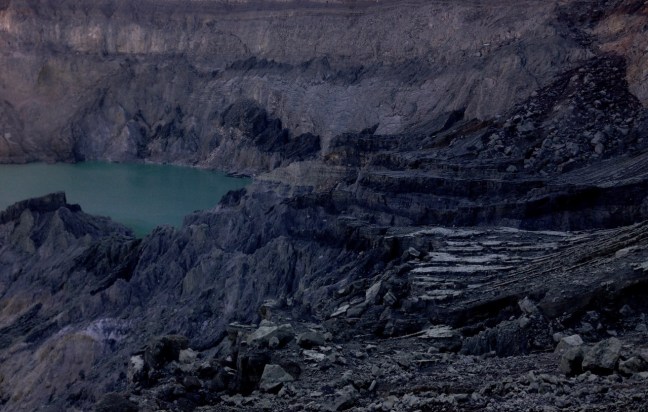
It is cold. It is dark. It is 1:45 am, yet the steep, but not strenuous, hike up Ijen and all the way down into the crater are worth the effort. At the crack of dawn, just in that limbo moment between light and dark, blue flames passionately dance in the depths of the crater right beside us. As it turns out this natural phenomena is just the beginning of the spectacle… As the sky lightens up for the new day to start, I feel we have somehow been tele-transported into a faraway planet. Wearing masks to avoid breathing the toxic gas, a cloud of thick white smoke flirts with the fluorescent yellow rocks that dress the crater. Brighter morning light unveils a lake of impossibly opaque fluorescent light blue color, a perfect compliment to the acid yellow hue of the sulfuric rocks. We are all mesmerized by such beauty…
Local men mine the sulfur from the side of the crater. A hard job. Their faces wrapped in old rags to avoid the fumes and pick in hand, they brake off big chunks of the mineral as if fighting a fierce dragon and carry the heavy blocks on handmade baskets, balanced on their shoulders, slow and steady, all the way up the steep side of the crater. One bare foot in front of the other. Admirable. Heartbreaking…
We leave Java overwhelmed with adrenaline from all the power, intensity and beauty that we have witnessed. The Dayak people of Northern Kalimantan await for us, and so are our friends Cara and Safia who will meet us there too!





Kalimantan is the Indonesian side of the island of Borneo. Border to Malaysia, North Kalimantan is the newest province of Indonesia and the least populated one. A 3 hour boat ride from Tarakan to Malinau, followed by a bumpy drive uphill and we arrive to the village of Setulang, home to the Dayak people, the heirloom inhabitants of Kalimantan.
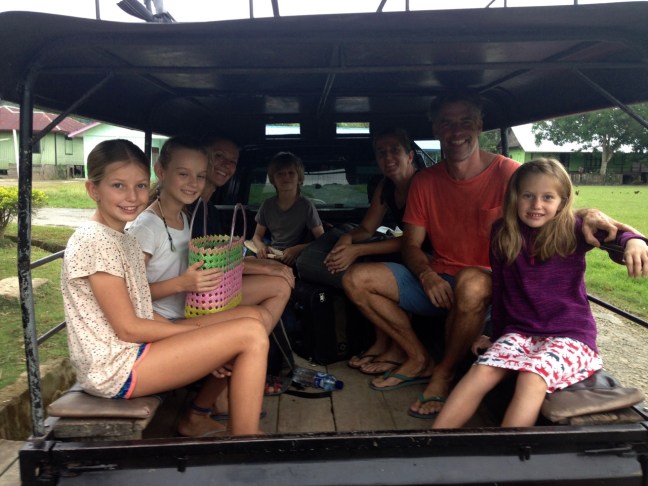
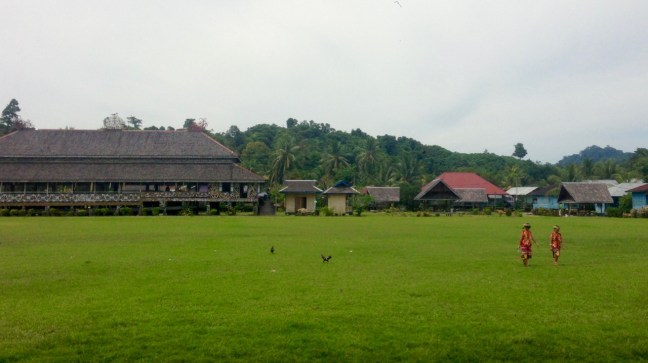
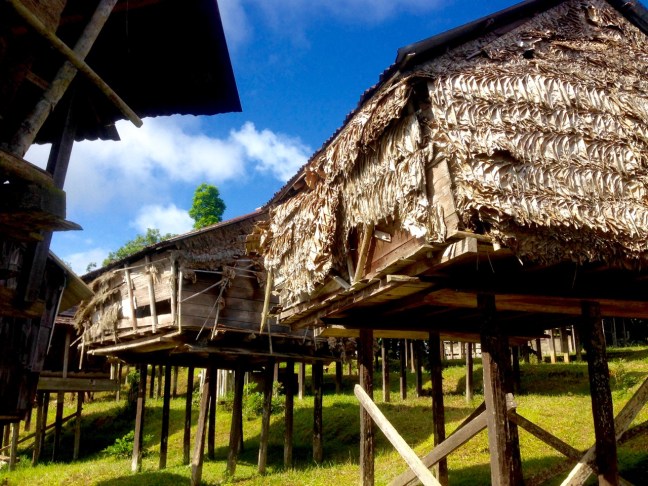
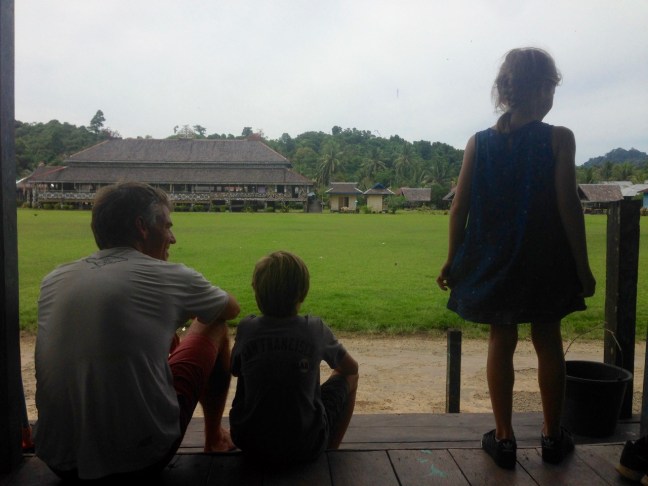
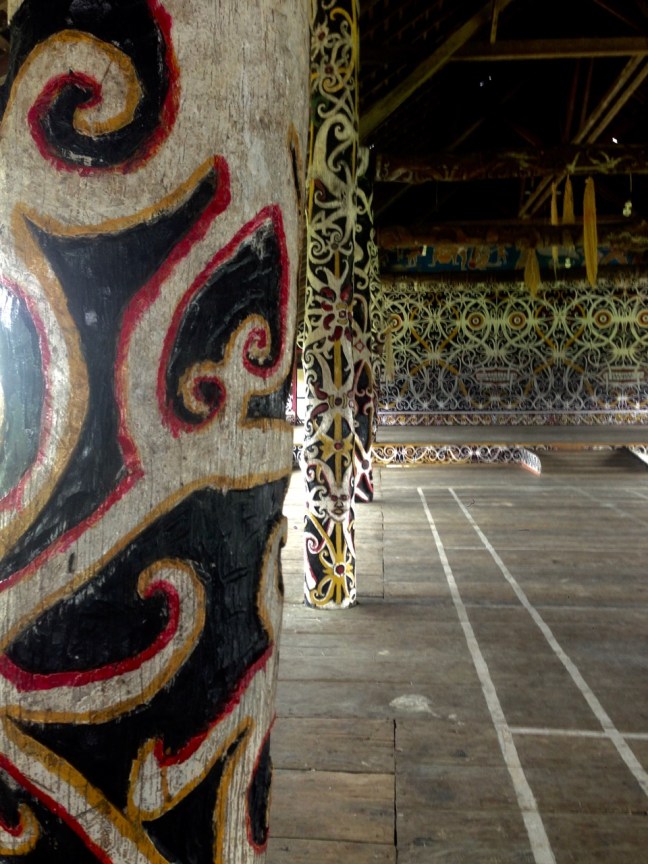
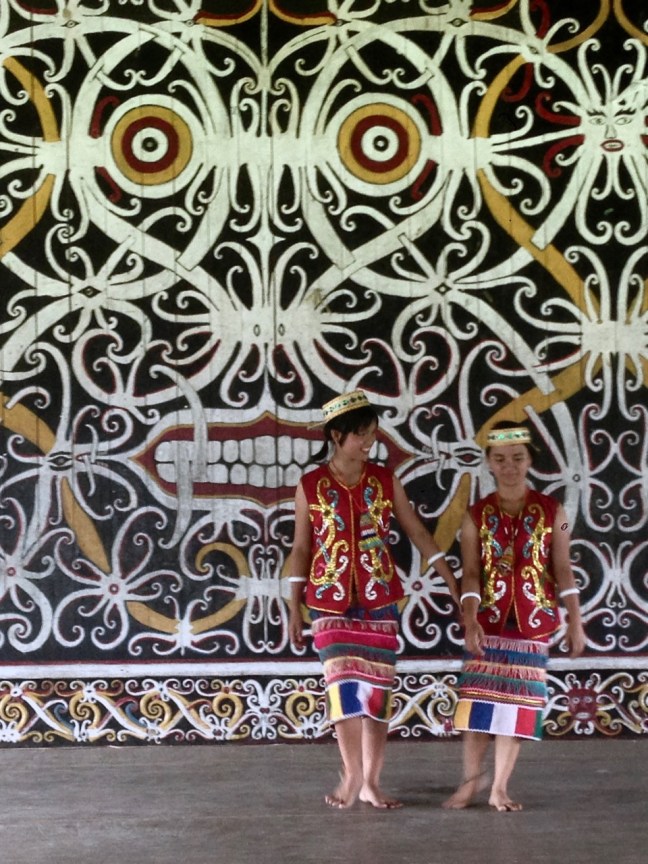
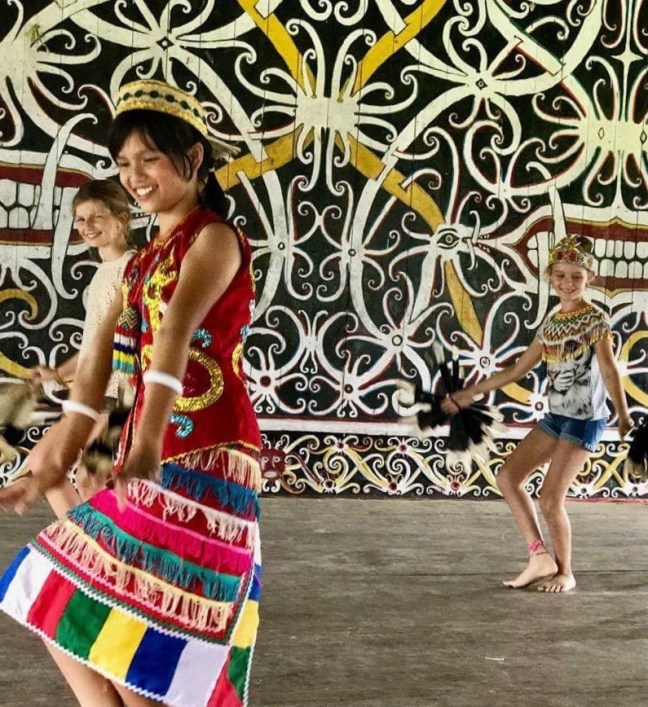
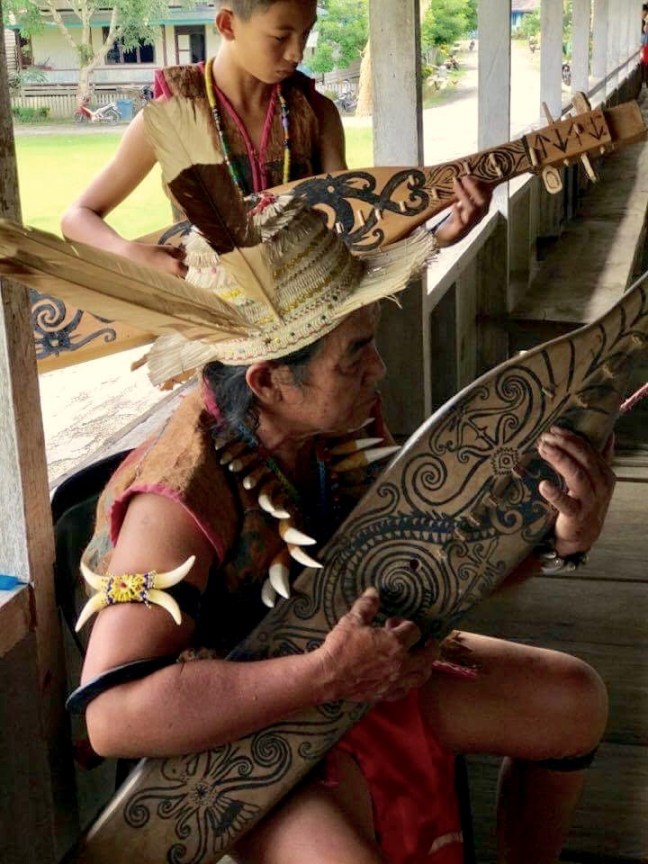
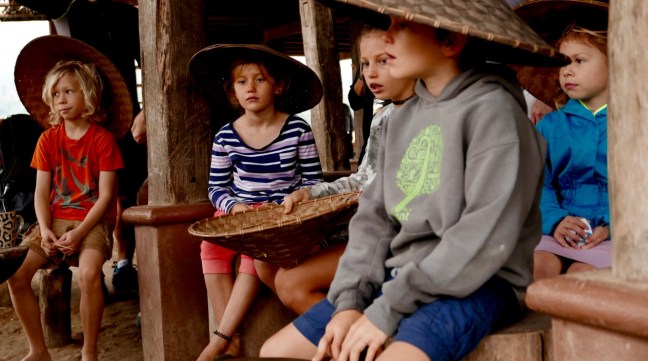
Surrounded by pristine jungle, the village feels welcoming and peaceful. Ample, semi-paved streets are lined on either side by picturesque wooden homes on stilts. At the center of town, a massive bright green field. To the side, stands the Long House, beautifully carved and painted with traditional Dayak motifs. The Long House is the community building, central to village life, where dances, music, meetings and community gatherings take place. Ibu Rostina and her family generously host us in their home as if we were The Royals. Traditional live music is in the air and before we know it, Marcus is playing soccer on the field and the local girls have invited our kids onstage, in the Long House, to practice all together the local dance that they are rehearsing.
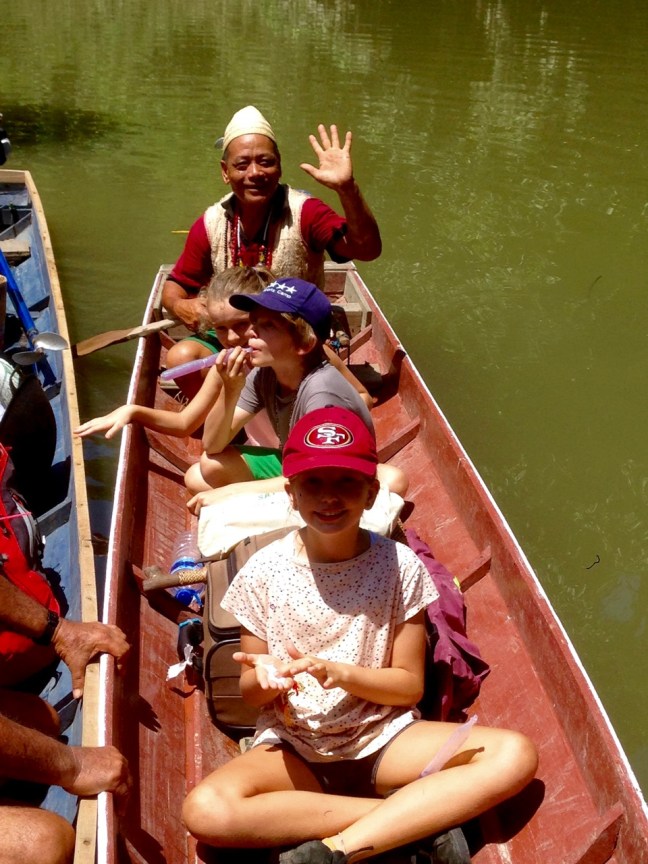
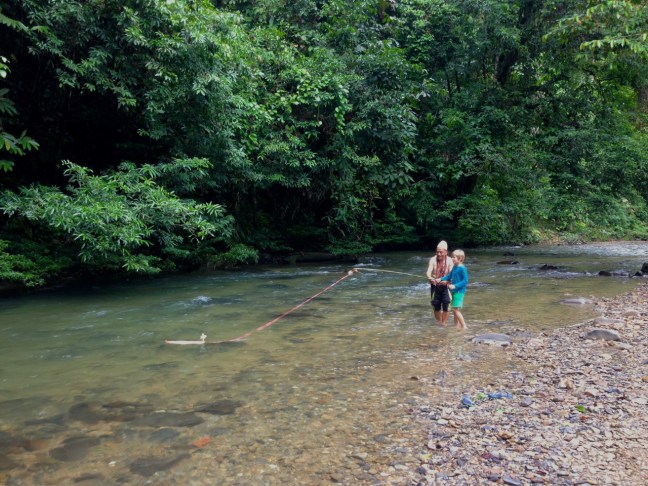
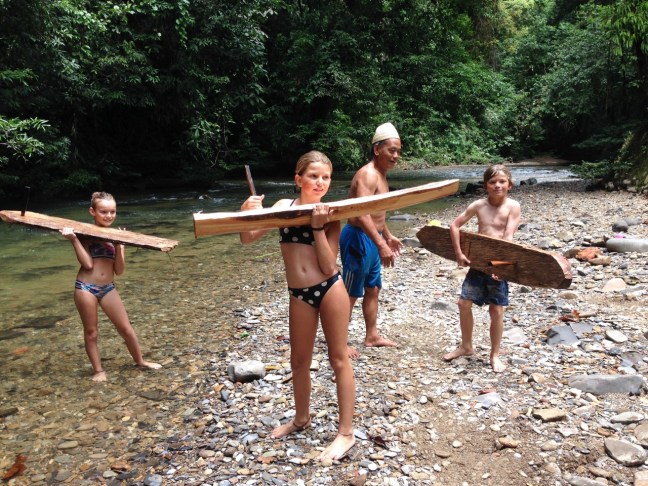
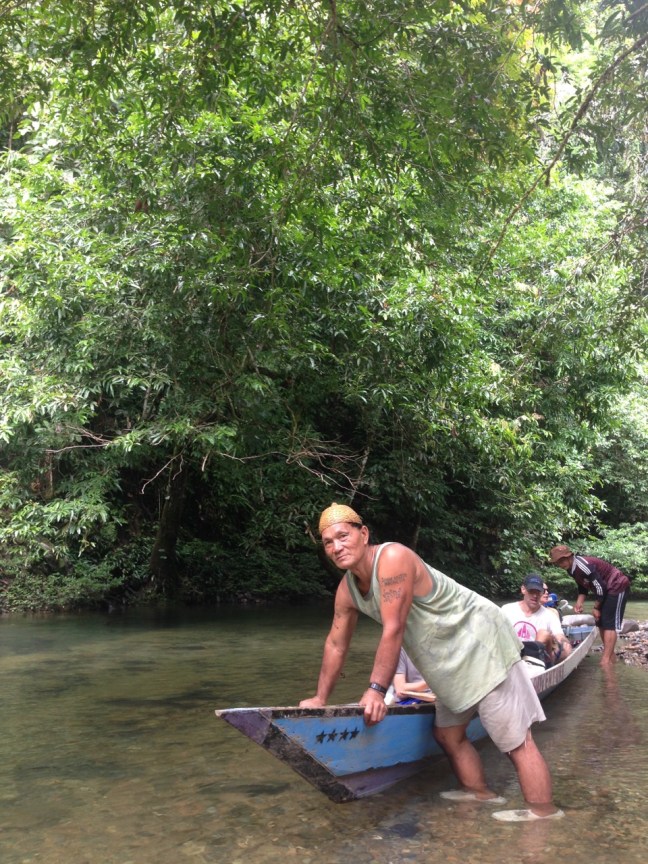
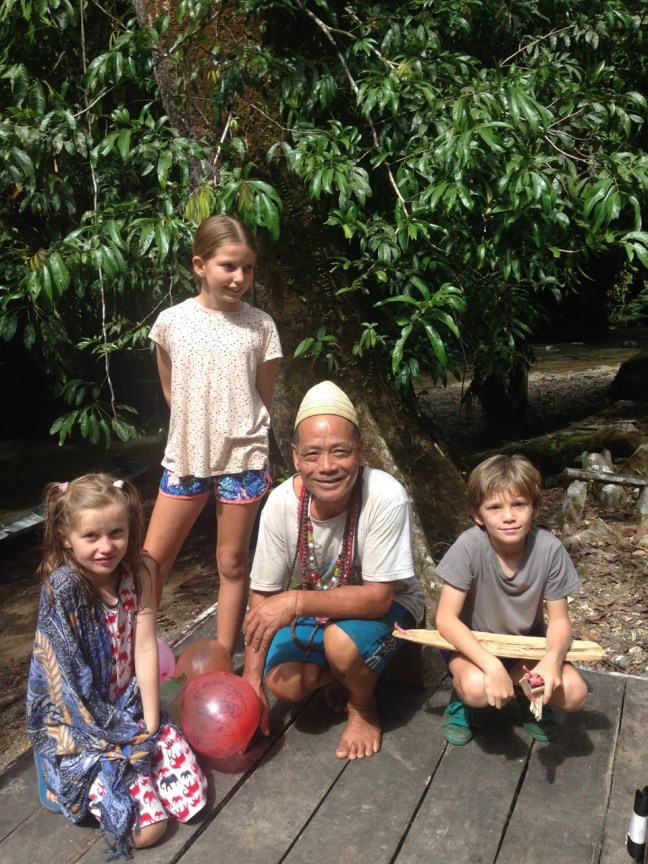
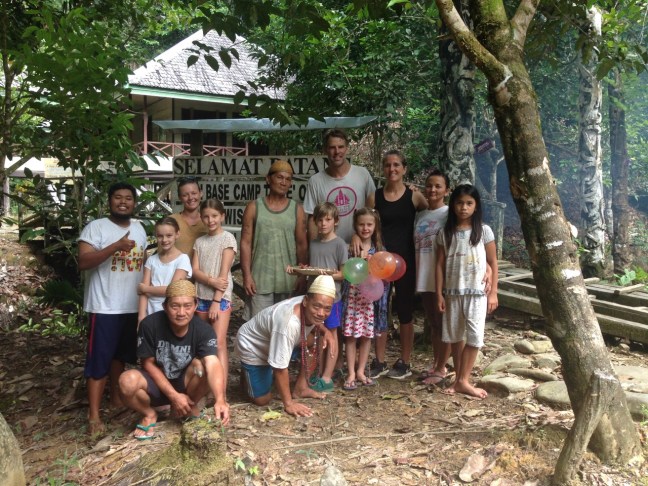
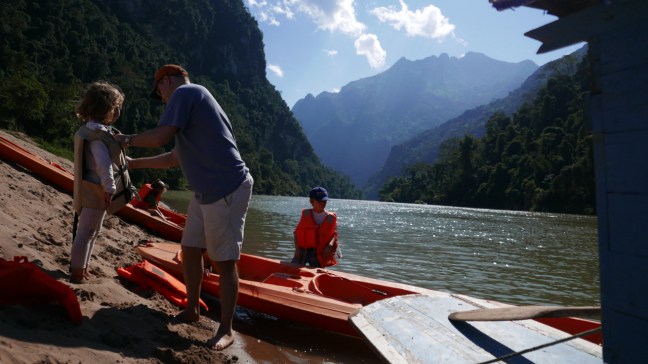
The following day, an army of Dayak villagers take us upriver to their jungle camp. It is a technical boat ride but they move skillfully and confidently and master the unexpected challenges of this effluent of the Setulang River. For the next 4 days, Mother Nature, Pak Phillius and Pak Krimson, true Dayak men of the jungle full of wisdom, will provide for us.
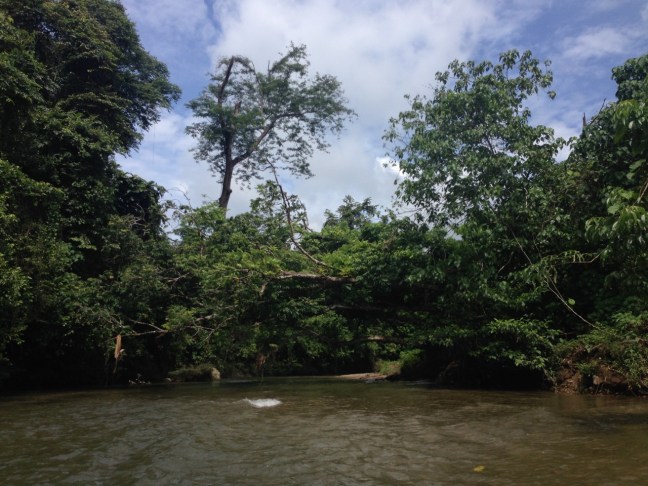
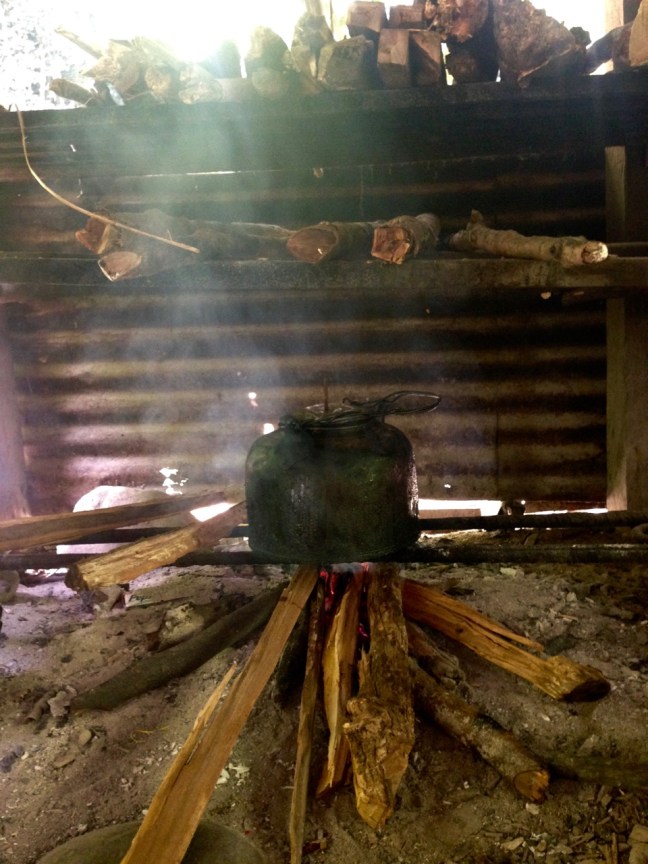
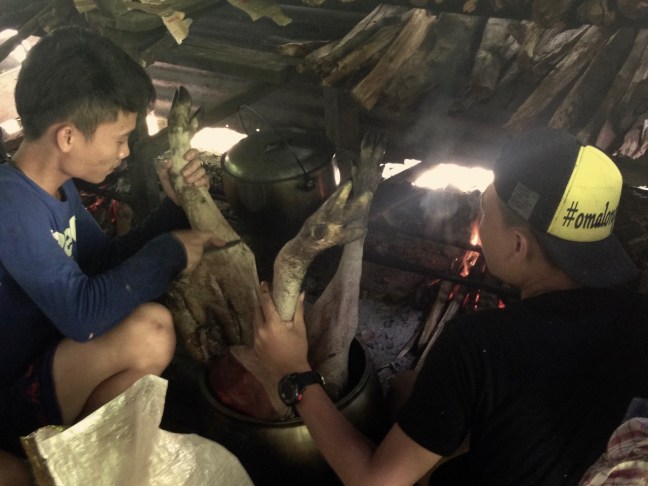
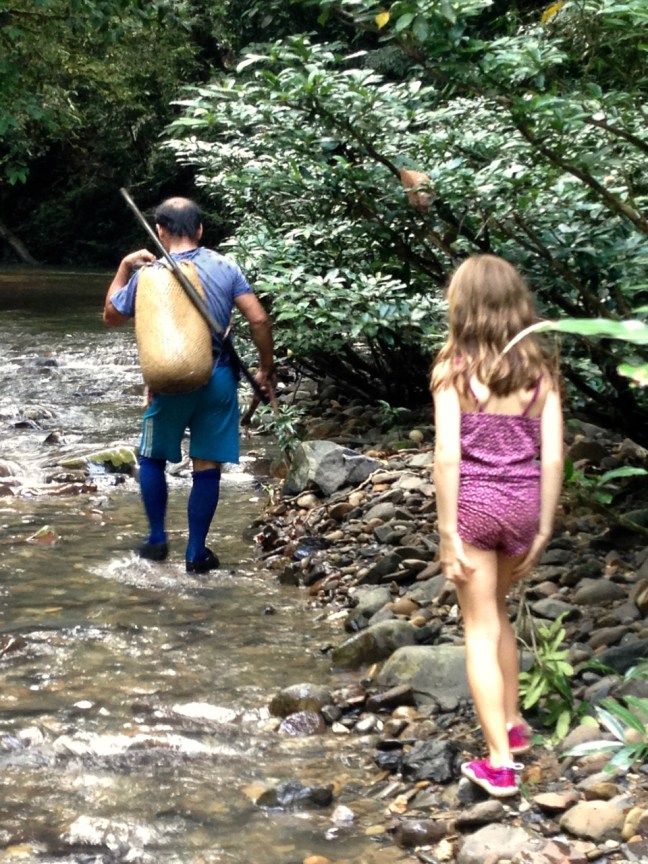
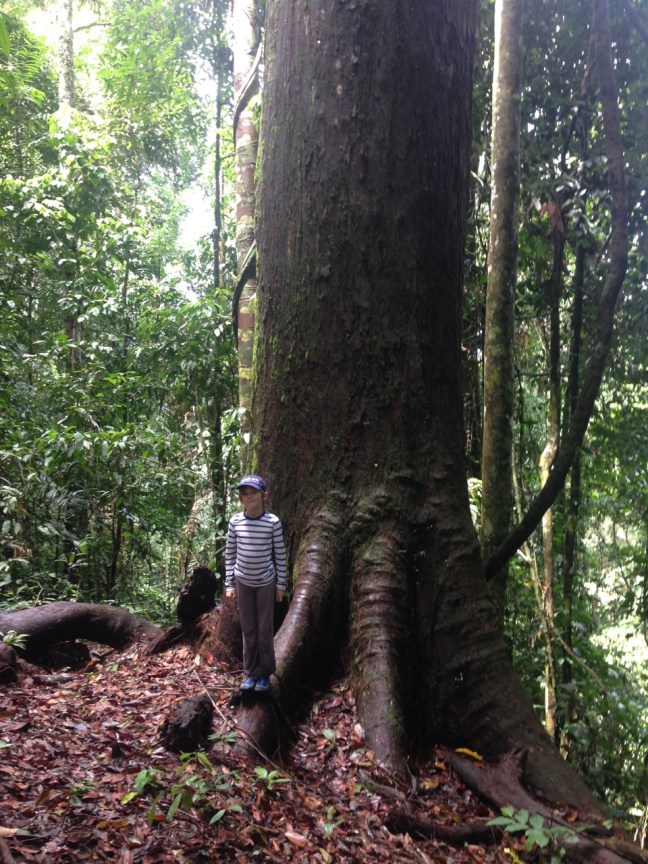
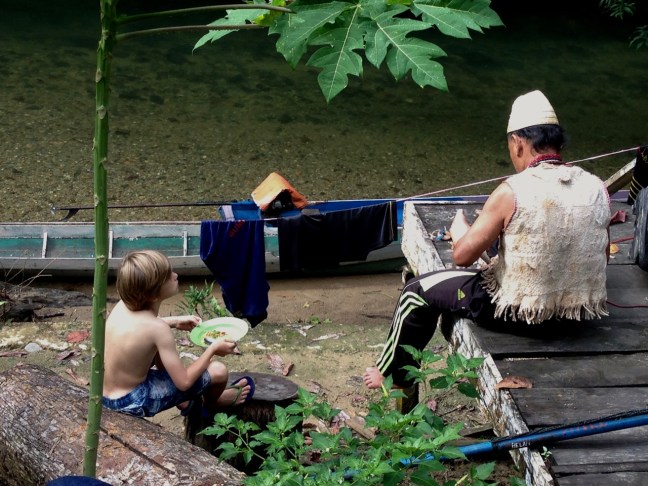
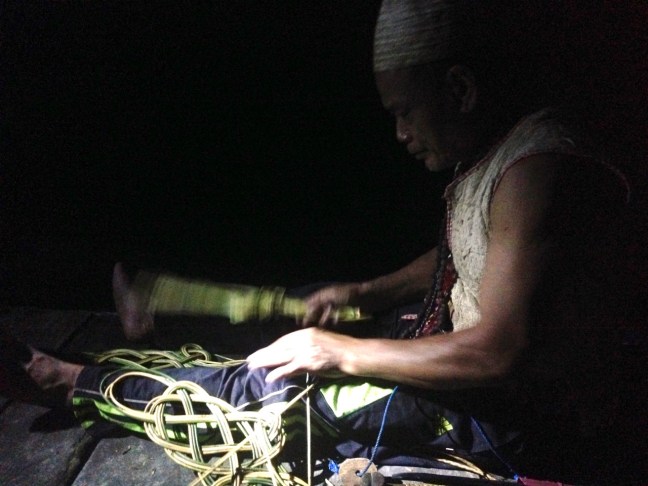
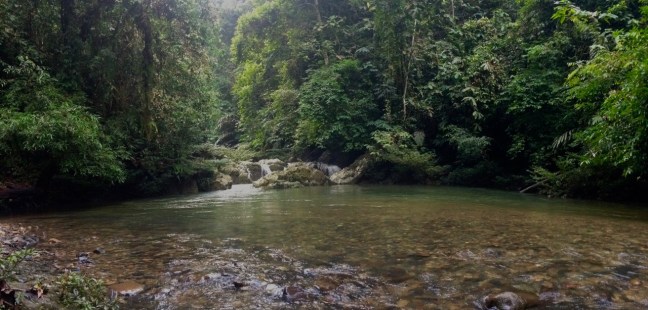
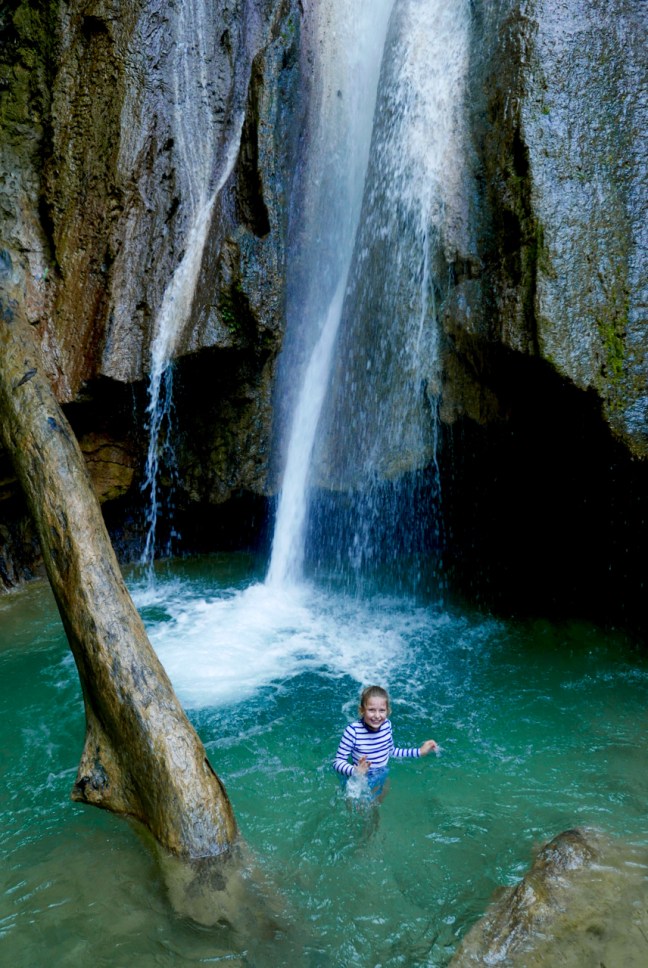
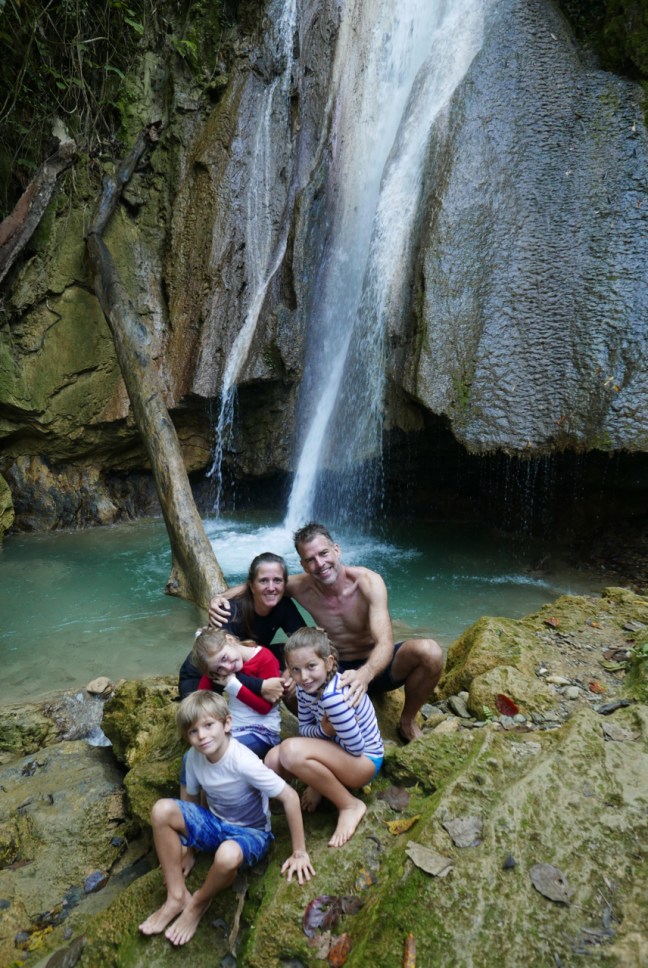
Home to one of the richest biodiversity habitats in the world, this remote and untouched jungle of Northern Kalimantan is full of animals that our dormant western instincts don’t allow us to see but for sure our ears hear. Ahhhh… life in the wilderness at last! Phenomenal. Daily “showers” in the crystal-clear waters of the river, exciting leech-infested hikes, pristine waterfall swims, magical dipping holes, majestic ancient trees taller than my neck can bend up to see, colorful butterflies the size of birds, raging storms of roaring thunder and torrential downpours, warm rays of sunlight dancing through the lace of the thick jungle canopy… welcome to the Garden of Eden, or so it feels, as this land has been virgin, untouched and unharmed for longer than our ancestors’ ancestors’ have lived. At night, traditional prayers requesting a fruitful hunting season, tribal chants and dances around the fire tower that Pak Phillius and Pak Krimson so expertly have built.
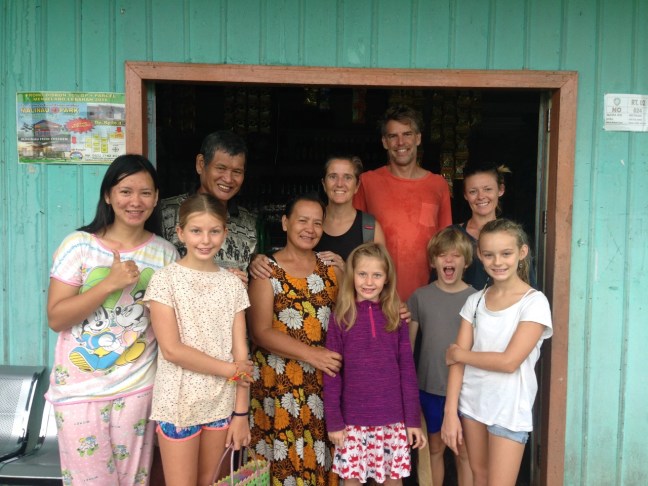
Upon returning to Setulang village, Ibu Rostina and her family await for us once again with open arms. It is hard to believe that our 5 weeks of travels are coming to an end. In 48 hours we will be back in Bali and then back to the US. We are enamored of Indonesia’s natural beauty, amazed by the variety and richness of its islands, fascinated by its vibrant culture and grateful for its wise and openhearted people.






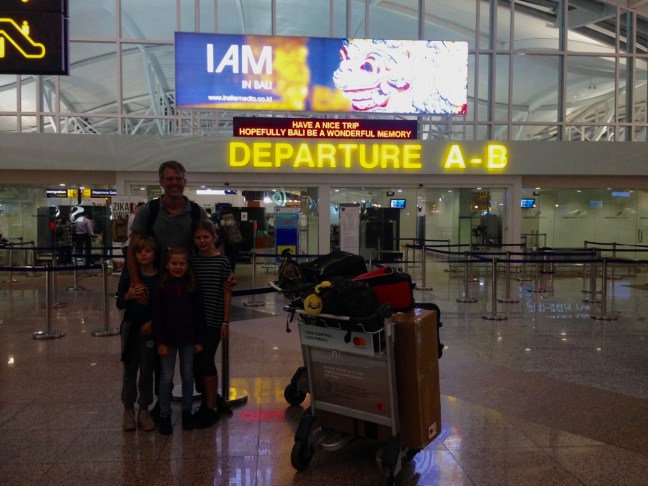
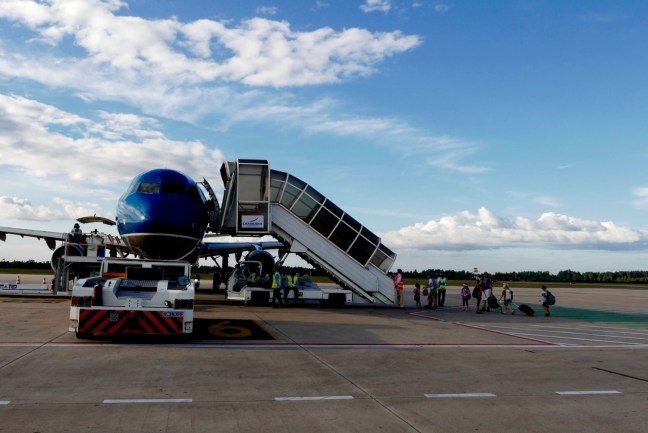
Back in Bali, after two incredible days with dear friends giving us their hearts, the moment arrives and we must go. As we fly out of Denpasar one last time, en route to California, tears stream down our cheeks. Sitting on the plane, our hands hold each other tight in the form of a long, sturdy, unbreakable chain across the row. All five of us. Our eyes wide open. We study the island we have called home one last time, from the early morning bright sky. Bali is gifting us again with its beauty and with each tear that runs down my cheek I realize that I am crying out of pure gratitude for the last two years that have given us the space to grow strong and tall. Individually. Together.
Sampai jumpa lagi, Bali. We are ready to write our next chapter in California. Grammy and Grandpa here we come!





























 theintrepid5: the Kaltreider adventure